Gli attori e le misure a favore della diversità delle specie sono numerosi – un impegno di questo tipo è diventato una tendenza. Uno degli approcci più diffusi e largamente accettati consiste nel promuovere le api mellifere. Come ogni tendenza, però, anche questa merita uno sguardo critico. Ci si chiede da quando una soluzione ben intenzionata e apparentemente verde contribuisca ai problemi ecologici anziché risolverli.
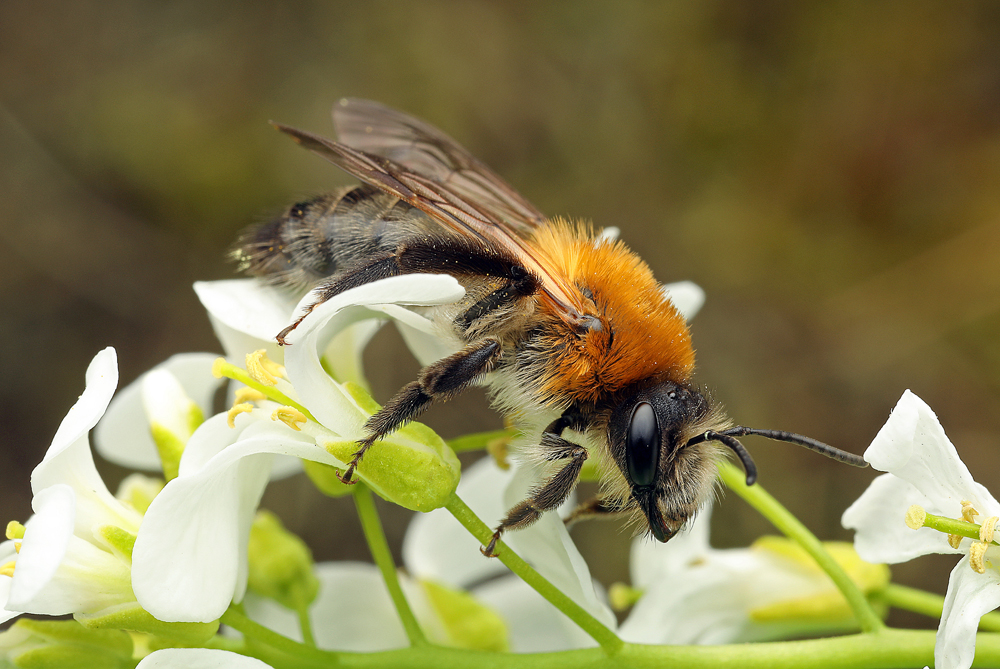
Foto: Andrena nitida è un’ape selvatica diffusa e non specializzata. L’immagine mostra un maschio. (Foto: © Jürg Sommerhalder)
Promozione delle api mellifere e perdita di biodiversità
Oltre agli apicoltori professionisti, oggi molti privati allevano api [1]. Aziende [2][3][4] e partiti politici [5] cercano inoltre di rendere più verde la propria immagine ricorrendo alla simpatica ape mellifera e sostengono perciò progetti a suo favore. In alcuni luoghi la densità di api mellifere aumenta così rapidamente e raggiunge già valori [6] che hanno chiaramente il potenziale di perturbare l’equilibrio ecologico – e quindi di contribuire all’ulteriore calo della diversità delle specie [7] [8].
Situazione di concorrenza
Da tempo gli esperti temono che api mellifere e api selvatiche possano farsi concorrenza. Sempre più studi esaminano perciò gli effetti di elevate densità di api mellifere sulla fauna locale di api selvatiche. Molti risultati indicano chiaramente che un’elevata densità di api mellifere:
- porta a concorrenza alimentare tra api mellifere e api selvatiche [9][10][11][12][13][14][15][16][17][18][19][20][21][22][23][24][25][26]
- soppianta le api selvatiche [10][11][12][13][20][22][23][24][25][26][27]
- può ridurre il numero e il vigore della prole delle api selvatiche [17][23][24][28][29] e
- favorisce la trasmissione di malattie dalle api mellifere a quelle selvatiche [19][30][31].
Già oggi quasi la metà delle 616 [32][33] specie di api selvatiche accertate per la Svizzera è considerata minacciata o estinta [34]. Le conseguenze a lungo termine di questo calo possono essere estremamente problematiche: le api selvatiche sono tra i più importanti impollinatori animali di piante selvatiche e coltivate [35][36]. Rientrano quindi tra le specie chiave degli ecosistemi terrestri e contribuiscono in modo determinante alla diversità delle specie [37][52][53].
Assenza di regolamentazione
Alcuni cantoni hanno già riconosciuto il problema dell’influsso di elevate densità di api mellifere sull’ambiente. Nelle riserve naturali dei cantoni di Berna [38] e Zurigo [39], per esempio, non vengono più rilasciate autorizzazioni per l’installazione di apiari. Una regolamentazione di questo tipo per tutta la Svizzera si fa però attendere. E anche nei due cantoni pionieri citati mancano le zone cuscinetto necessarie a una protezione efficace: il raggio di volo delle api mellifere può raggiungere tre chilometri e più [40]. Supera quindi nettamente il diametro della maggior parte delle zone protette del Canton Zurigo; nonostante il divieto, queste sono dunque di fatto poco protette.
Le densità più elevate si raggiungono oggi nelle città [41]. Secondo il servizio veterinario cantonale, in città di Zurigo il numero di apiari è aumentato dell’80 % dal 2014 [42]. Zone prive di pesticidi, ricche di strutture e di fiori, gli spazi edificati costituiscono habitat importanti e presentano spesso una impressionante varietà di api selvatiche. In città si possono così osservare molte specie rare e minacciate [43] [44]. Appare quindi particolarmente problematico che l’allevamento di api mellifere non sia regolamentato negli spazi urbani più di quanto lo sia nelle zone classiche con flora e fauna degne di protezione.
Secondo la prassi attuale, apiari e colonie devono solo essere notificati al servizio veterinario competente. Questo non verifica eventuali limitazioni nel luogo interessato. Manca quindi una regolamentazione secondo criteri quantitativi e qualitativi [44]. Inoltre l’obbligo di notifica viene ignorato da alcuni apicoltori e non è fatto rispettare dalle autorità [45].
Percezioni errate, campagne fuorvianti e carenza di informazione
La detenzione di api mellifere è intesa come misura a favore della biodiversità e anche come contributo importante al mantenimento della sicurezza dell’impollinazione e dell’approvvigionamento alimentare. Numerosi studi mostrano però che il ruolo delle api mellifere nell’impollinazione di piante selvatiche e coltivate è per lo più sopravvalutato [46][47][48][49].
I rendimenti agricoli più elevati si ottengono infatti con la maggiore varietà possibile di impollinatori naturali [36][47]. Una densità troppo elevata di api mellifere ha quindi un effetto controproducente anche negli agroecosistemi e dunque sul piano economico [50][51].
Le campagne a favore delle api mellifere che poggiano su affermazioni scientificamente insostenibili traggono perciò in inganno il pubblico, relegano in secondo piano le misure efficaci per la diversità delle specie e la sicurezza dell’impollinazione e immobilizzano risorse preziose in progetti poco utili. Sforzi di informazione timidi o assenti favoriscono questa evoluzione.
Sfruttare il potenziale
IG Wilde Biene è convinta che, grazie a informazioni scientificamente fondate, a un lavoro di informazione e a misure mirate, sia possibile un’inversione di tendenza verso un ambiente di nuovo più ricco di specie e più sano.
FONTI
[1] Charrière J.D., Frese S. & Herren P. 2018. Bienenhaltung
in der Schweiz. Agroscope Transfer 250: 24 S.
[2] https://www.mobiliar.ch/die-mobiliar/engagement/unsere-haltung/mobees-bei-der-mobiliar-bienen-im-einsatz-fuer-die-zukunft
[3] https://www.swisscom.ch/de/about/unternehmen/nachhaltigkeit/bienen.html
[4] https://www.heutefuermorgen.ch/de/projekte/bienen/aldi-suisse-bienenhaeuser.html
[5] https://www.fdp-zh.ch/news-pool/wir-machen-biodiversitaet?id=53941
[6] Schriftliche Mitteilungen des Veterinäramts Zürich (Februar 2020)
[7] Burger R. 2018. Wildbienen first – unsere wichtigsten Bestäuber und die Konkurrenz mit dem Nutztier Honigbiene. Naturkunde aus dem Südwesten 1 (2018): 7 S.
[8] Burkle L.A., Marlin J.C. &Knight T.M. 2013: Plant-Pollinator Interactions over 120 Years: Loss of Species, Co-Occurrence, and Function. Science 339: 1611–1615.
[9] Geldmann J. & González-Varo J.P. 2018. Conserving honey bees does not help wildlife; high densities of managed honey bees can harm populations of wild pollinators. Science 359 (6374): 392–393.
[10] Henry M. & Rodet G. 2018. Controlling the impact of the managed honeybee on wild bees in protected areas. Scientific Reports 8: 10 pp. doi: 10.1038/s41598-018-27591-y
[11] Goulson D., Stout J.C. & Kells A.R. 2002. Do exotic bumblebees and honeybees compete with native flower-visiting insects in Tasmania? Journal of Insect Conservation 6: 179–189.
[12] Gross C.L. 2001. The effect of introduced honeybees on native bee visitation and fruit-set in Dillwynia juniperina (Fabaceae) in a fragmented ecosystem. Biological Conservation 102 (1): 89–95.
[13] Schaffer W.M., Zeh D.W., Buchmann S.L., Kleinhans S., Schaffer M.V. & Antrim J. 1983. Competition for nectar between introduced honey bees and native North American bees and ants. Ecology 64 (3): 564–577.
[14] Cane J.H. & Tepedino V.J. 2017. Gauging the Effect of Honey Bee Pollen Collection on Native Bee Communities. Conservation Letters 10 (2): 205–210. doi.org/10.1111/conl.12263
[15] Geslin B., Gauzens B., Baude M., Dajoz I., Fontaine, C., Henry M., Ropars L., Rollin O., Thébault E. & Vereecken N.J. 2017. Massively Introduced Managed Species and Their Consequences for Plant–Pollinator Interactions. Advances in Ecological Research 57: 147–199. doi.org/10.1016/bs.aecr.2016.10.007
[16] Torné-Noguera A., Rodrigo A., Osorio S. & Bosch J. 2016. Collateral effects of beekeeping: Impacts on pollen-nectar resources and wild bee communities. Basic and Applied Ecology 17 (3): 199–209.
[17] Goulson D. & Sparrow K. 2008: Evidence for competition between honeybees and bumblebees; effects on bumblebee worker size. Journal of Insect Conservation. 13 (2): 177–181.
[18] Requier F., Odoux J-F., Tamic T., Moreau N., Henry M., Decourtye A. & Bretagnolle V. 2015. Honey bee diet in intensive farmland habitats reveals an unexpectedly high flower richness and a major role of weeds. Ecological Applications 25 (4): 881–890.
[19] Mallinger R.E., Gaines-Day H.R. & Gratton C. 2017. Do managed bees have negative effects on wild bees?; a systematic review of the literature. Plos One 12 (12): 32 pp. doi.org/10.1371/journal.pone.0189268
[20] Ropars L., Dajoz I., Fontaine C., Muratet A. & Geslin B. 2019. Wild pollinator activity negatively related to honey bee colony densities in urban context. Plos One 14 (9): 16 pp. doi.org/10.1371/journal.pone.0222316
[21] Shavit O., Dafni A. & Ne’eman G. 2009. Competition between honeybees (Apis mellifera) and solitary bees in the Mediterranean region of Israel; implications for conservation. Israel Journal of Plant Sciences 57: 171–183.
[22] Valido A., Rodríguez-Rodríguez M.C. & Jordano P. 2019. Honeybees disrupt the structure and functionality of plant-pollinator networks. Scientific Reports 9: 11 pp. doi.org/10.1038/s41598-019-41271-5
[23] Evertz S. 1993. Untersuchungen zur interspezifischen Konkurrenz zwischen Honigbienen (Apis mellifera L.) und solitären Wildbienen (Hymenoptera, Apoidea). unpubl. Dissertation, Technische Hochschule Aachen. 123 S.
[24] Evertz S. 1995. Interspezifischen Konkurrenz zwischen Honigbienen (Apis mellifera) und solitären Wildbienen (Hymenoptera, Apoidea). Natur und Landschaft 70: 165–172.
[25] Thomson D.M. 2006. Detecting the effects of introduced species: A case study of competition between Apis and Bombus. Oikos 114: 407–418.
[26] Walther-Hellwig K., Fokul G., Frankl R., Büchler R., Ekschmitt K. & Wolters V. 2006. Increased density of honeybee colonies affects foraging bumblebees. Apidologie 37: 517–532. doi: 10.1051/apido:2006035
[27] Henry M. & Rodet G. 2018. Controlling the impact of the managed honeybee on wild bees in protected areas. Scientific Reports 8: 10 pp. doi: 10.1038/s41598-018-27591-y
[28] Thomson D. 2004. Competitive interactions between the invasive European honey bee and native bumble bees. Ecology 85: 458-470.
[29] Goodell K. 2000. The impact of honey bees on native solitary bees: Competition and indirect effects. PhD thesis. New York, State University of New York, Stony Brook.
[30] Alger S.A., Burnham P.A., Boncristiani H.F. & Brody A.K. 2019. RNA virus spillover from managed honeybees (Apis mellifera) to wild bumblebees (Bombus sp.). Plos One 14 (6): 9 pp. doi.org/10.1371/journal.pone.0217822
[31] Fürst M.A., McMahon D.P., Osborne J.L., Paxton R.J., Brown M.J.F. 2014. Disease associations between honeybees and bumblebees as a threat to wild pollinators. Nature 506: 364–366. doi: 10.1038/nature12977
[32]Pfiffner L. & Müller A. 2016. Wildbienen und Bestäubung. Faktenblatt FIBL 1633: 8 S.
[33] info fauna – Centre Suisse de Cartographie de la Faune (CSCF)
[34] Amiet F. 1994. Rote Liste der gefährdeten Bienen der Schweiz. In Duelli P. (Red.): Rote Listen der gefährdeten Tierarten in der Schweiz. BUWAL (Hrsg.), EDMZ (Vertrieb), Bern. S. 38–44.
[35] Michener, C.D. 2007. The bees of the world (second edition). Johns Hopkins Univ. Press, Baltimore. 992 pp.
[36] Garibaldi L.A., Steffan-Dewenter I., Winfree R., Aizen M.A., Bommarco R., Cunningham S.A., Kremen C., Carvalheiro L.G., Harder L.D., Afik O., Bartomeus I., Benjamin F., Boreux V., Cariveau D., Chacoff N.P., Dudenhöffer J.H., Freitas B.M., Ghazoul J., Greenleaf S., Hipólito J., Holzschuh A., Howlett B., Isaacs R., Javorek S.K., Kennedy C.M., Krewenka K.M., Krishnan S., Mandelik Y., Mayfield M.M., Motzke I., Munyuli T., Nault B.A., Otieno M., Petersen J., Pisanty G., Potts S.G., Rader R., Ricketts T.H., Rundölf M., Seymour C.L., Schüepp C., Szentgyörgyi H., Taki H., Tscharntke T., Vergara C.H., Viana B.F., Wanger T.C., Westphal C., Williams N. & Klein A.M. 2013. Wild pollinators enhance fruit set of crops regardless of honey bee abundance. Science 339: 1608–1611.
[37] Kratochvil A. 2003. Bees as key-stone species; specifics of resource and requisite utilization in different habitat types. Berichte der Reinhold-Tüxen-Gesellschaft 15: 59–77.
[38] Merkblatt Bienenvölker in Naturschutzgebieten 2018. Abteilung für Naturförderung, Kanton Bern.
[39] Schriftliche Mitteilung (2020, E-Mail) Martin Graf, Amt für Landschaft und Natur, Fachstelle Naturschutz, Kanton Zürich.
[40] Ribbands C.R. 1951. The Flight Range of the Honey-Bee. Journal of Animal Ecology, 20 (2): 220–226.
[41] von Büren R.S., Oehen B., Kuhn N.J. & Erler S. 2019. High-resolution maps of Swiss apiaries and their applicability to study spatial distribution of bacterial honey bee brood diseases. PeerJ 7: 21 pp. doi.org/10.7717/peerj.6393
[42] Schriftliche Mitteilung (2020, Email) Urte Hinrichs, Veterinäramt, Gesundheitsdirektion, Kanton Zürich.
[43] Zurbuchen A., Müller A. 2012. Wildbienenschutz – von der Wissenschaft zur Praxis. Bristol-Schriftenreihe 33: 162 S.
[44] Schriftliche Mitteilungen des Veterinäramts Zürich (Februar 2020)
[45] Persönliche Mitteilung (2019) verschiedener ImkerInnen, bspw. Christine Cariget und Doris Allrich.
[46] Breeze T.D., Bailey A.P., Balcombe K.G. & Potts S.G. 2011. Pollination services in the UK: how important are honeybees. Agriculture, Ecosystems and Environment 142: 137–143.
[47] Garibaldi, L.A., Steffan-Dewenter, I., Winfree, … & Klein, A.M. 2013. Wild pollinators enhance fruit set of crops regardless of honey bee abundance. Science, 339, 1608-1611.
[48] Eeraerts M., Vanderhaegen R., Smagghe G. & Meeus I. 2020. Pollination efficiency and foraging behaviour of honey bees and non‐Apis bees to sweet cherry. Agricultural and Forest Entomology 22 (1): 75–82.
[49] Holzschuh A., Dudenhöffer J.-H. & Tscharntke T. 2012. Landscapes with wild bee habitats enhance pollination, fruit set and yield of sweet cherry. Biological Conservation 153: 101–107.
[50] Sáez A., Morales C.L., Ramos L.Y. & Aizen M.A. 2014. Extremely frequent bee visits increase pollen deposition but reduce drupelet set in raspberry. Journal of Applied Ecology 51: 1603–1612.
[51] Rollin O. & Garibaldi L.A. 2019. Impacts of honeybee density on crop yield: A meta‐analysis. Journal of Applied Ecology 56: 1152–1163.
[52] Ollerton J., Winfree R. & Tarrant S. 2011. How many flowering plants are pollinated by animals? Oikos 120 (3): 321–326.
[53] Peters R.S., Krogmann L., Mayer C., Donath A., Gunkel S., Meusemann K., Kozlov A., Podsiadlowski L., Petersen M., Lanfear R., Diez P.A., Heraty J., Kjer K.M., Klopfstein S., Meier R., Polidori C., Schmitt T., Liu S., Zhou X., Wappler T., Rust J., Misof B. & Niehuis O. 2017. Evolutionary History of the Hymenoptera. Current Biology 27 (7): 1013–1018 + Suppl. Inf.