
Wild bee or insect hotels are enjoying growing popularity. These artificial dwellings for cavity-nesting bees are not only sold commercially in every conceivable shape and form, they are also a much-loved craft project for children. We explain how and where such nesting aids should be used – and where they should not.
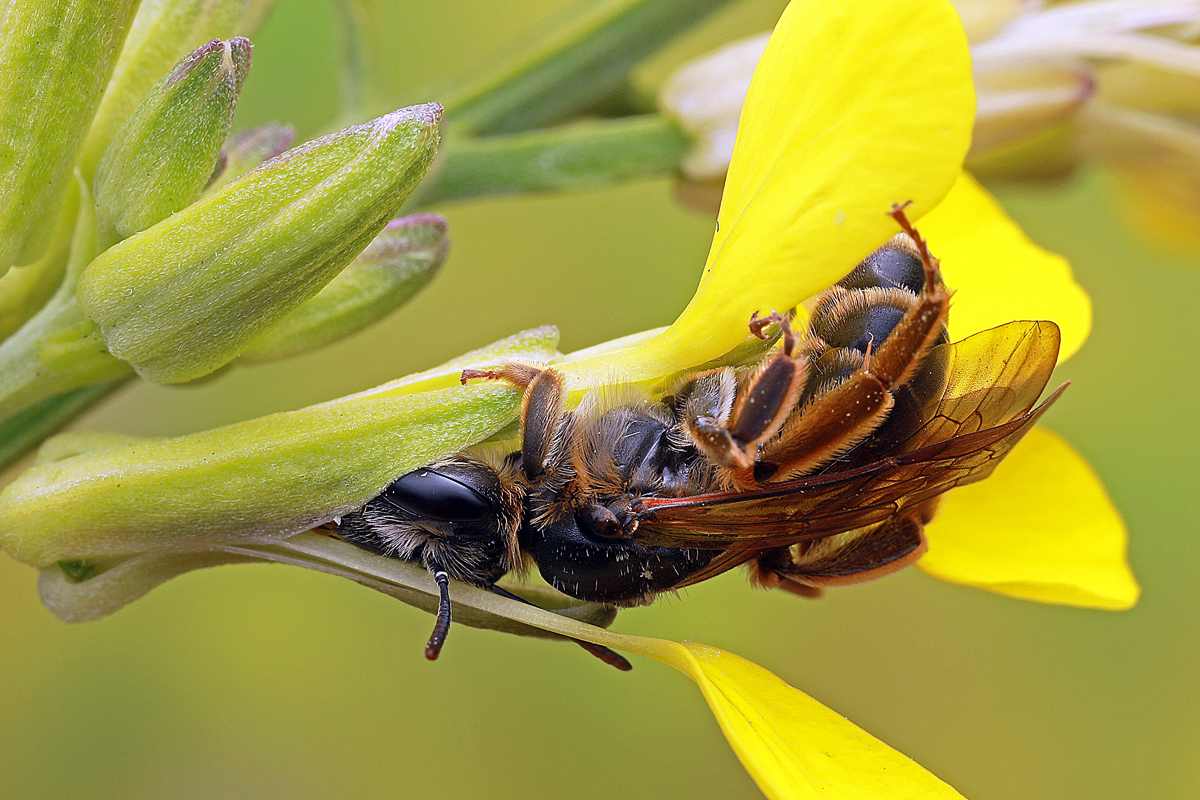
Photo: The female of Andrena probata, a mining bee, flies only in the Valais. It is specialised on large-flowered crucifers such as the Swiss treacle mustard (Erysimum rhaeticum, pictured; photo: © Jürg Sommerhalder).
Wild bee hotels: ecologically insignificant
Putting up a wild bee or insect hotel does not contribute to biodiversity. The reasons are easily explained: typical nesting aids provide homes for cavity-nesting wild bees, that is, species that build their nests in existing cavities. They account for 5% of all native species. Many of them are entirely unthreatened and need no support. Only rarely does a threatened species stray into a wild bee hotel.
The benefit of a wild bee hotel is therefore limited to the chance of watching a few mostly common species nesting at close quarters. Incidentally, these constructions attract more than bees: wasps, beetles and other arthropods are happy to move in as well.
Ecologically questionable: pre-stocked wild bee hotels with “starter populations”
Using pre-stocked wild bee hotels can be downright disastrous: bred mason bees (usually the European orchard bee, Osmia cornuta) are in this way introduced into areas where they do not occur naturally. That the arrival of a new, non-native species can affect the local wild bee fauna is self-evident: competition for nest sites and food resources becomes greater still. Steer well clear of such offers!
What really helps
- Create nesting structures around your wild bee hotel that are as varied as possible, and make sure nectar and pollen are available all year round.
- Provide nesting aids by creating patches of bare ground, so that ground-nesting species have easy access for digging their burrows.
- Push dry bramble canes from the previous season, around 50 cm long, into the ground or tie them to fence posts: this creates nest sites for species that nest in pithy stems. Above all they like upright stems accessible from above – the horizontal ones in bee hotels are ignored by most species.
- Leave dead, woody plants such as teasels and evening primroses standing for at least two years: in the first summer after they die they are occupied by pith-stem nesters, and in the second year their offspring emerge.
- Offer old deadwood as a nest site to deadwood-nesting species such as the carpenter bee, as harmless as it is huge and shimmering blue. A thick, gnarled old branch or root stock can, incidentally, look very fine in a garden.
- Avoid artificial fertilisers, herbicides and pesticides.
Conclusion
As long as you are aware that more is needed to support wild bees properly, there is nothing wrong with owning or wanting to build a wild bee hotel. All the more so when it is done for and with children, who can be introduced to nature and enthused by it in this way. We refrain here from giving our own tips on building good wild bee hotels, and refer you instead to the pages of the German wild bee specialist Paul Westrich, who explains in detail how bees with specific nesting requirements can be helped (in German):
-> Basics
-> Supporting cavity nesters (A)
-> Nesting aids for cavity nesters (B)
-> Unsuitable nesting aids (A)
-> Unsuitable nesting aids (B)
-> Supporting pith-stem nesters
-> Supporting deadwood nesters
-> Supporting steep-bank nesters
-> Supporting ground nesters
Further reading
If the subject interests you, we recommend our article on it in the autumn 2022 bulletin (no. 23) of our partner association FREETHEBEES, from page 23 onwards (in German).
> Read the FTB bulletin now