At Wehntalerstrasse 46/54, a wild bee pocket park of some 250 m² was created in the course of landscaping around a newly built residential building – in the middle of a residential neighbourhood.
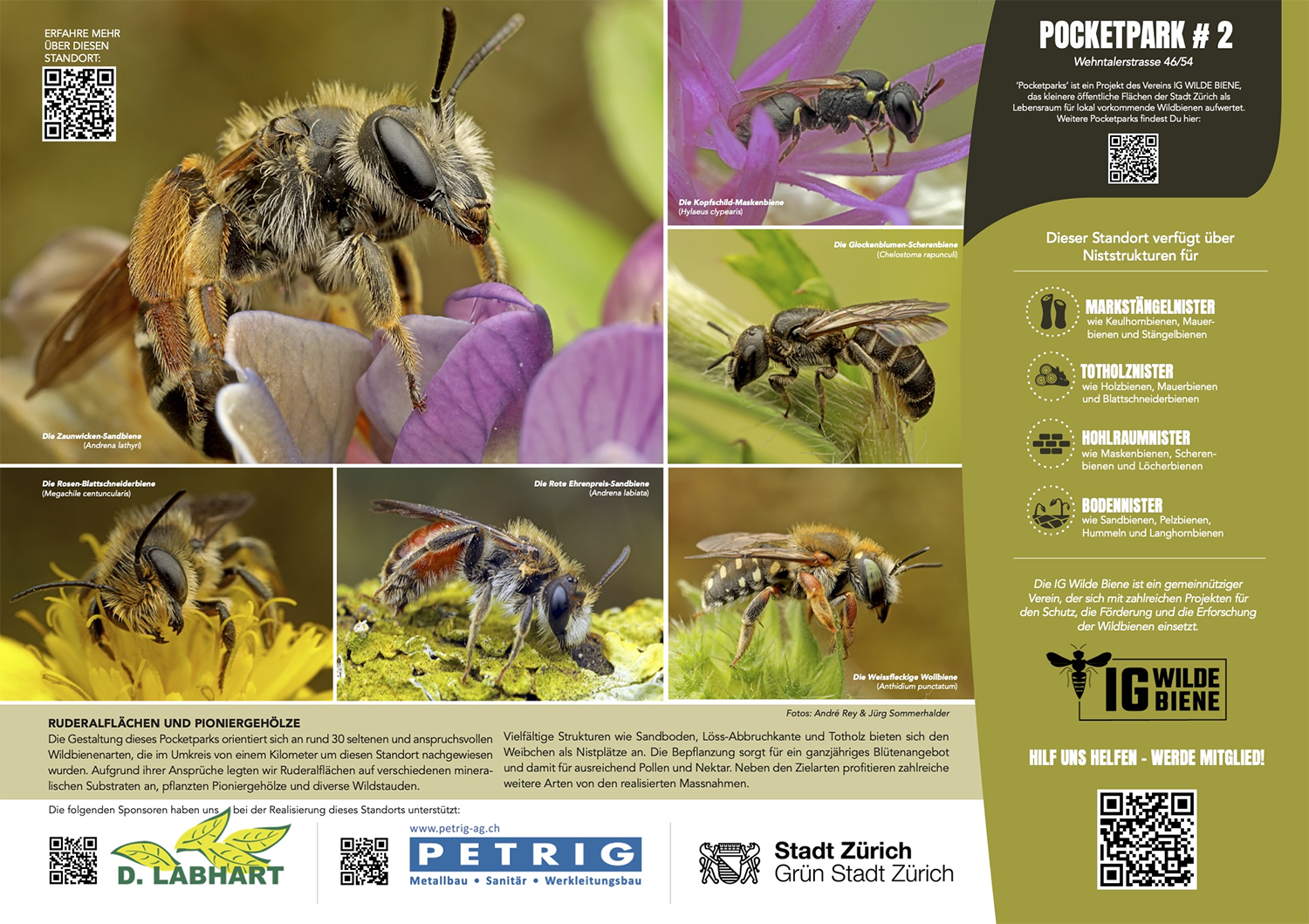
Target species
More than 200 wild bee species have so far been recorded for the well-surveyed city of Zurich. Drawing on data from recent wild bee surveys in the district concerned, the project team identified the following locally occurring wild bees as priority target species for this site:
| • Dichtpunktierte Körbchensandbiene: Andrena combinata • Rote Ehrenpreis-Sandbiene: Andrena labiata • Zweizellige Sandbiene: Andrena lagopus • Zaunwicken-Sandbiene: Andrena lathyri • Grosse Weiden-Sandbiene: Andrena vaga • Blaue Ehrenpreis-Sandbiene: Andrena viridescens • Weissfleckige Wollbiene: Anthidium punctatum • Vierfleck-Pelzbiene: Anthophora quadrimaculata • Spätes Scherenbienchen: Chelostoma campanularum • Frühes Scherenbienchen: Chelostoma distinctum • Glockenblumen-Scherenbiene: Chelostoma rapunculi • Buckel-Seidenbiene: Colletes daviesanus • Rainfarn-Seidenbiene: Colletes similis • Kopfschild-Maskenbiene: Hylaeus clypearis • Schmalkopf-Maskenbiene: Hylaeus leptocephalus |
• Rainfarn-Maskenbiene: Hylaeus nigritus • Schilfgallen-Maskenbiene: Hylaeus paulus • Mauer-Maskenbiene: Hylaeus pictipes • Lauch-Maskenbiene: Hylaeus punctulatissimus • Reseden-Maskenbiene: Hylaeus signatus • Grünglänzende Schmalbiene: Lasioglossum nitidulum • Wald-Schenkelbiene: Macropis fulvipes • Rosen-Blattschneiderbiene: Megachile centuncularis • Gebänderte Blattschneiderbiene: Megachile circumcincta • Schwarzbürstige Blattschneiderbiene: Megachile nigriventris • Filzzahn-Blattschneiderbiene: Megachile pilidens • Luzernen-Blattschneiderbiene: Megachile rotundata • Natterkopf-Mauerbiene: Hoplitis adunca • Schöterich-Mauerbiene: Osmia brevicornis • Schwarzfühler-Holzbiene: Xylocopa valga |
Landscaping
Following the needs of the defined target species, and taking the existing conditions into account, substrates and structures were chosen that are capable of supporting all of the target species:
| Substrate: • Hummus (bestehend) • Wildbienensand • Wandkies (0-64mm) • Löss • Sandstein-Blöcke • Totholz |
Strukturen: • Hecken (teilweise bestehend) • Gehölze (teilweise bestehend) • Abbruchkante aus Löss • Steilwand aus Sand • Totholzstrünke |
Planting
Some existing woody plants (birch, walnut, cherry, field maple, ivy, wild cherry, hawthorn and blackthorn) line the north-western side of the park and screen it from the neighbouring building. At right angles to these, a willow hedge was planted at the rear, north-eastern end of the park. To the south-west, the low hedge of an adjoining property bounds the park. The new structures in between were planted (apart from the deliberately sparse vegetation of the sand and loess areas) with the following native wild perennials and bulbs:
| Achillea millefolium Allium ‚Cameleon‘ Allium ‚Miami‘ Allium acuminatum Allium ampeloprasum Allium caeruleum Allium carinatum Allium christophii Allium cowanii Allium oreophilum Allium sphaerocephalon Anchusa officinalis Anthemis arvensis Anthemis sancti-johannis Anthyllis vulneraria Artemisia absinthium Asperula orientalis Calamintha menthifolia Calamintha nepeta Campanula alliariifolia Campanula barbata Campanula cervicaria Campanula persicifolia Campanula poscharskyana Campanula rapunculoides Campanula rotundifolia Campanula trachelium Caragana arborescens Carduus crispus Carduus defloratus Carduus nutans Centaurea jacea Centaurea scabiosa |
Cephalaria ambrosioides Cephalaria leucantha Cirsium canum Cirsium japonicum Cirsium oleraceum Cirsium tuberosum Coronilla valentina Crupina vulgaris Cynara cardunculus Daucus carota Dianthus deltoides Diplotaxis erucoides Dipsacus fullonum Dipsacus laciniatus Echinops ritro Echium vulgare Eryngium planum Foeniculum vulgare Geranium asphodeloides Heracleum sphondylium Hesperis matronalis Isatis tinctoria Jasione laevis Knautia arvensis Knautia dipsacifolia Lamium album Lathyrus sylvestris Linaria genistifolia Lotus corniculatus Lythrum salicaria Nepeta tuberosa Onobrychis viciifolia Ononis spinosa |
Onopordum acanthium Onopordum cyprium Onosma echioides Orlaya grandiflora Pastinaca sativa Peucedanum verticillare Ptilostemon chamaepeuce Reseda luteola Salix caprea Salix purpurea Salvia candelabrum Salvia glutinosa Salvia pratensis Salvia sclarea Scabiosa columbaria Scrophularia nodosa Scutellaria altissima Seseli libanotis Silene dioica Stachys byzantina Stachys recta Stachys sylvatica Tanacetum corymbosum Tanacetum vulgare Teucrium chamaedrys Teucrium hircanicum Verbascum nigrum Veronica chamaedrys Veronica gentianoides Veronica prostrata Veronica teucrium Vicia cracca Zizia aurea |
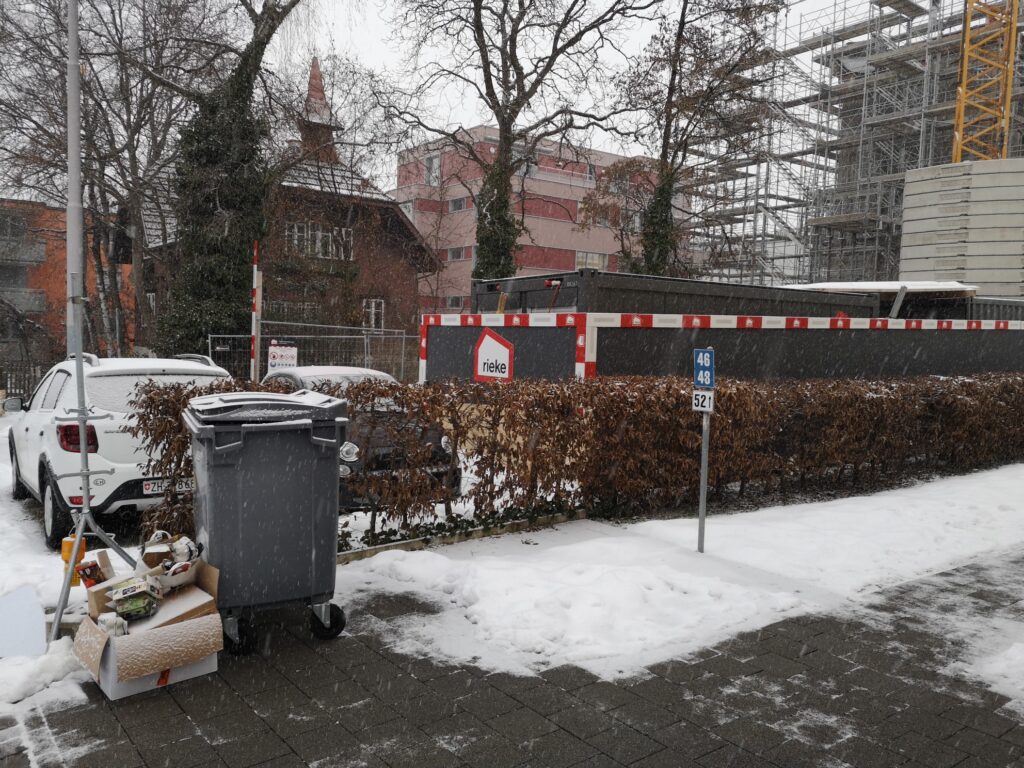
Late winter 2021: Before IG Wilde Biene took over the pocket park on Wehntalerstrasse, it served as a building depot for the construction of the new residential building visible at the back right. (Photo: André Rey)
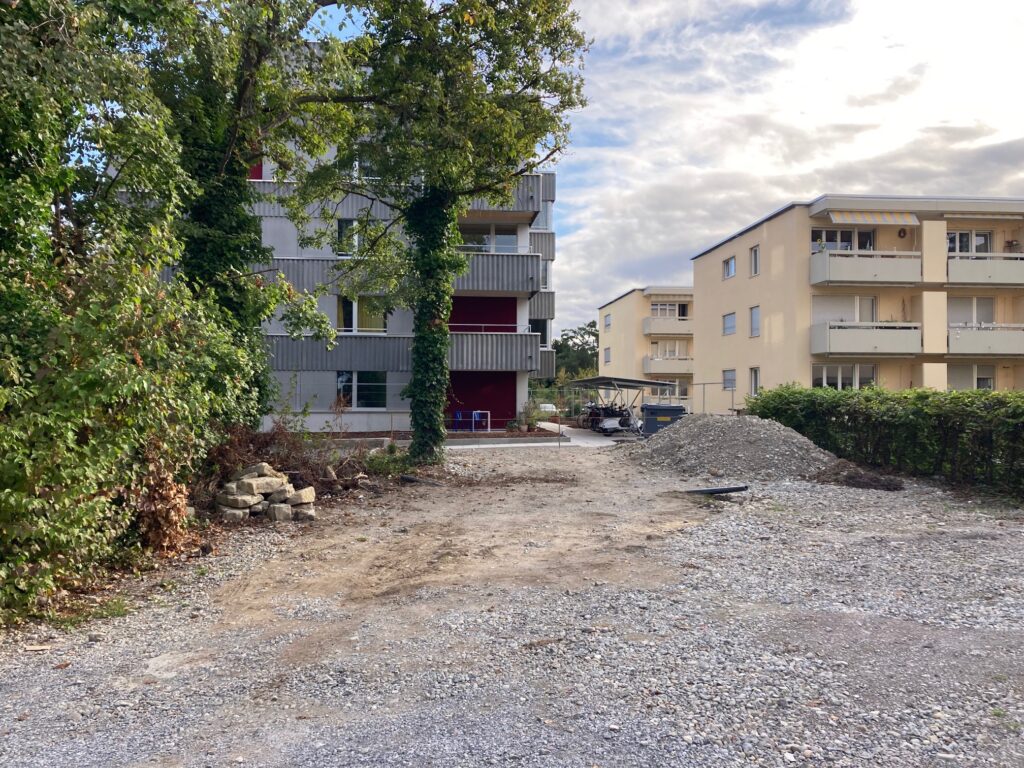
Summer 2021: The site after completion of the new building (photo: André Rey)
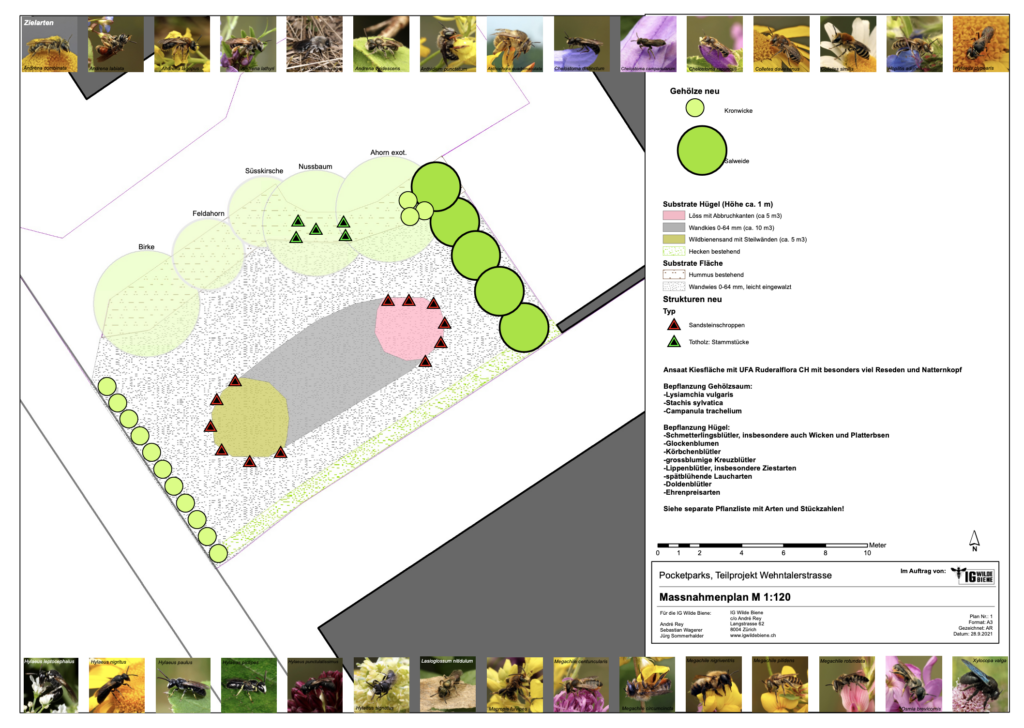
The improvement plan drawn up by our landscape architect André Rey.
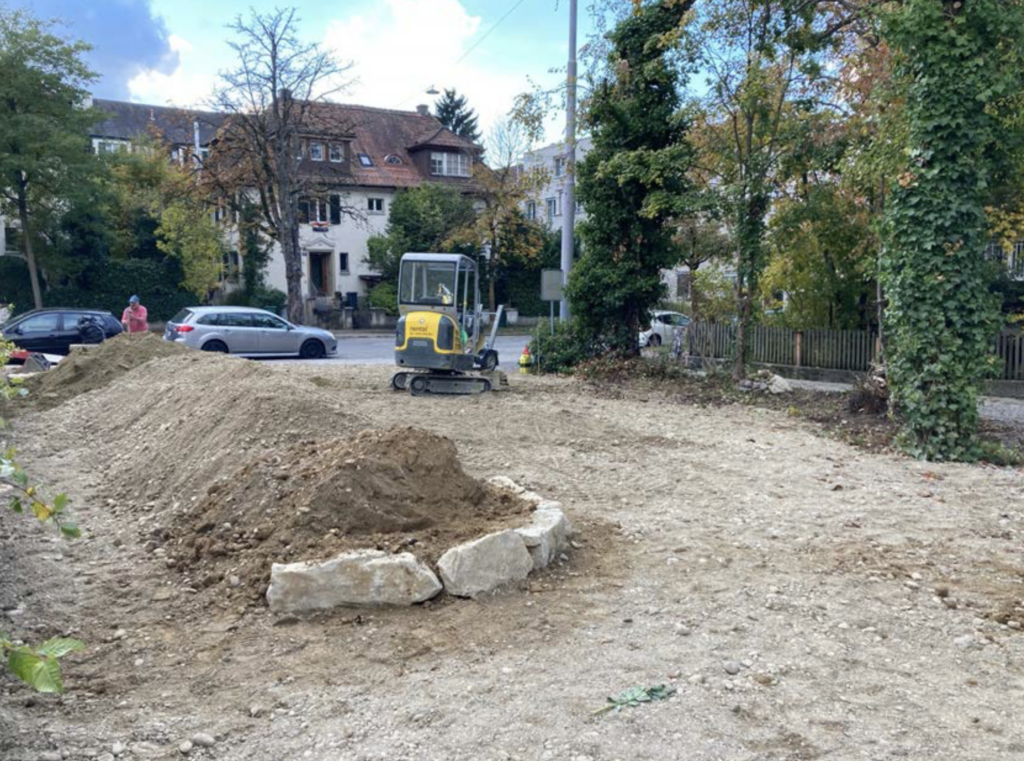
Autumn 2021: The improvement work has begun. (Photo: Sebastian Wagener)
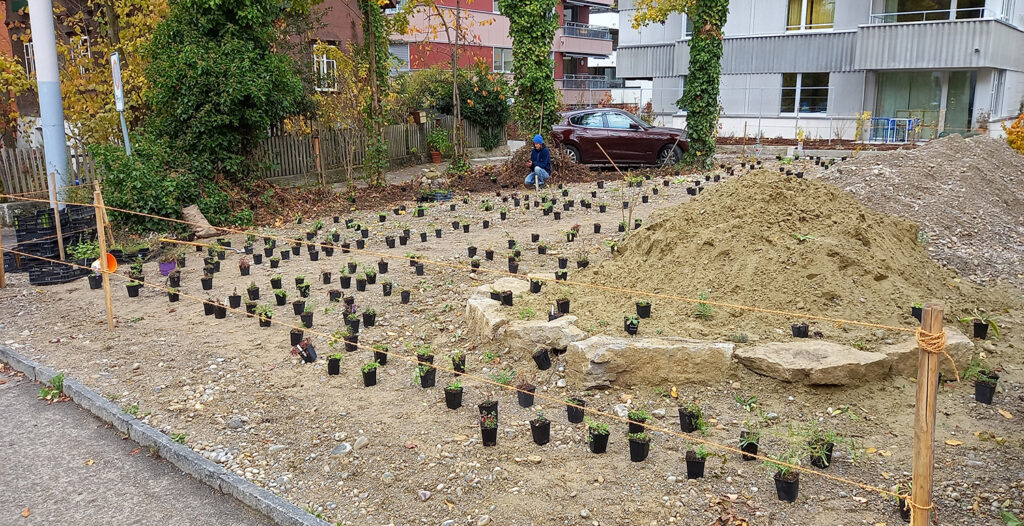
Autumn 2021: Several hundred seedlings of more than 100 native wild perennials go into the ground. (Photo: Sebastian Wagener)
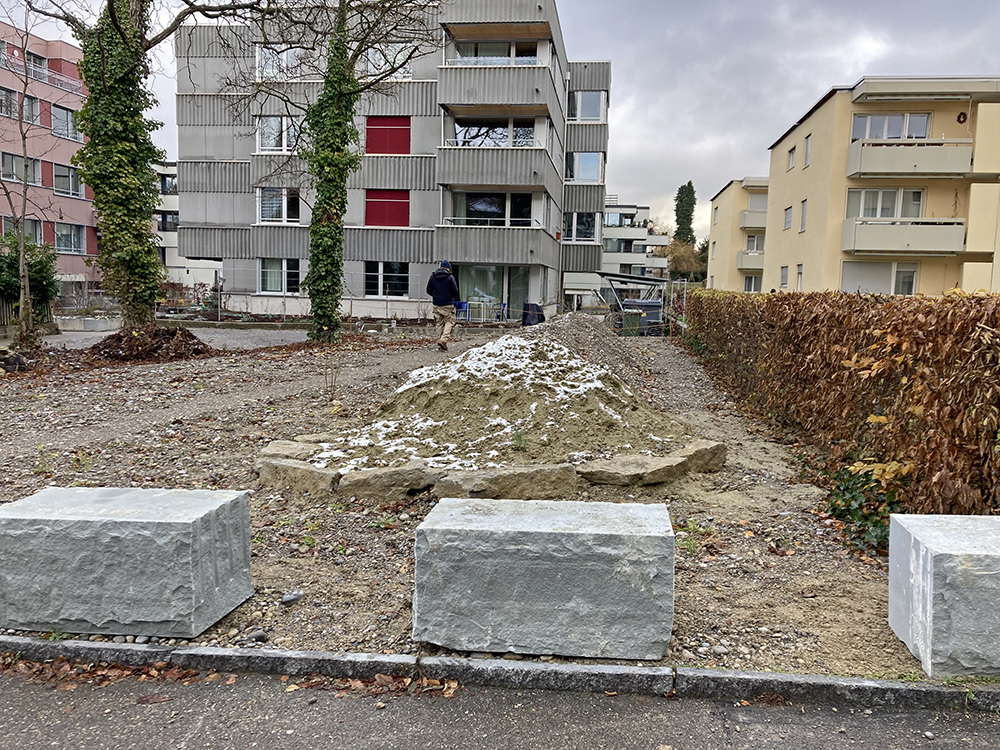
Winter 2021/2022: The large stone blocks in the foreground (seen from Wehntalerstrasse) prevent the area from being misused as a car park. Behind them lies the sand and loess bank for wild bees that nest in steep faces. (Photo: Sebastian Wagener)
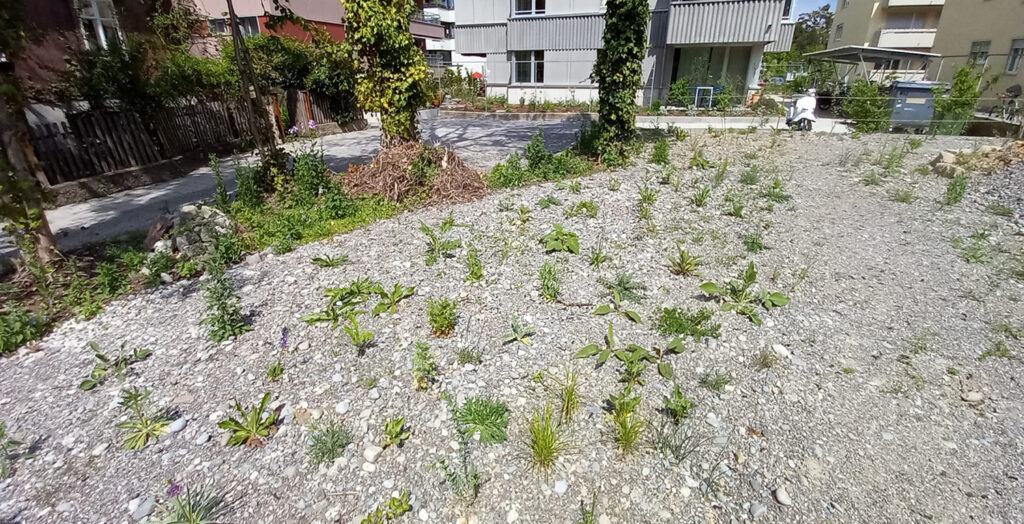
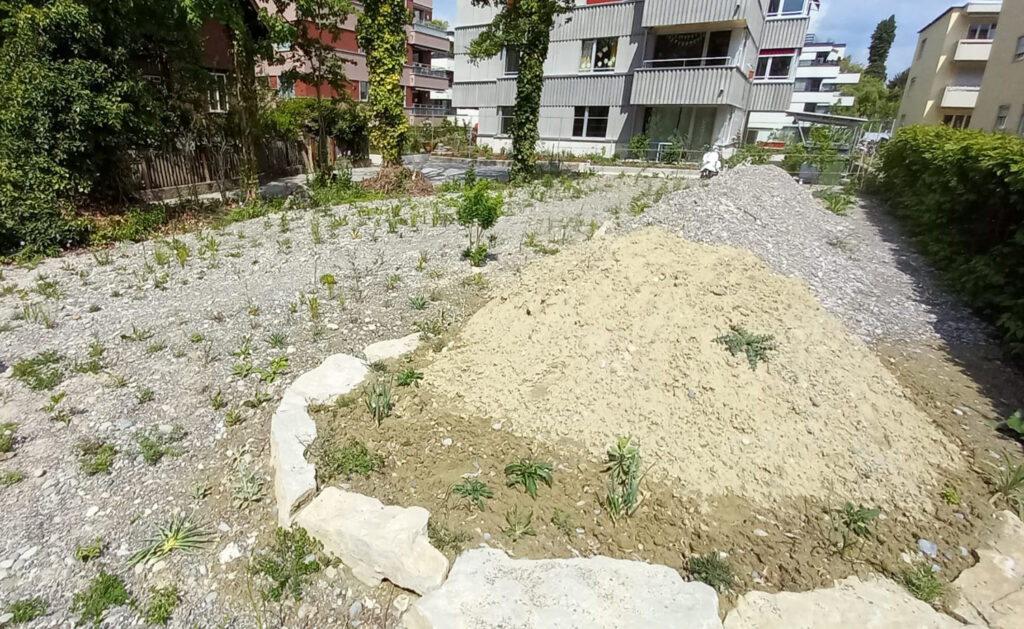
Spring 2022: The planting begins to sprout and…
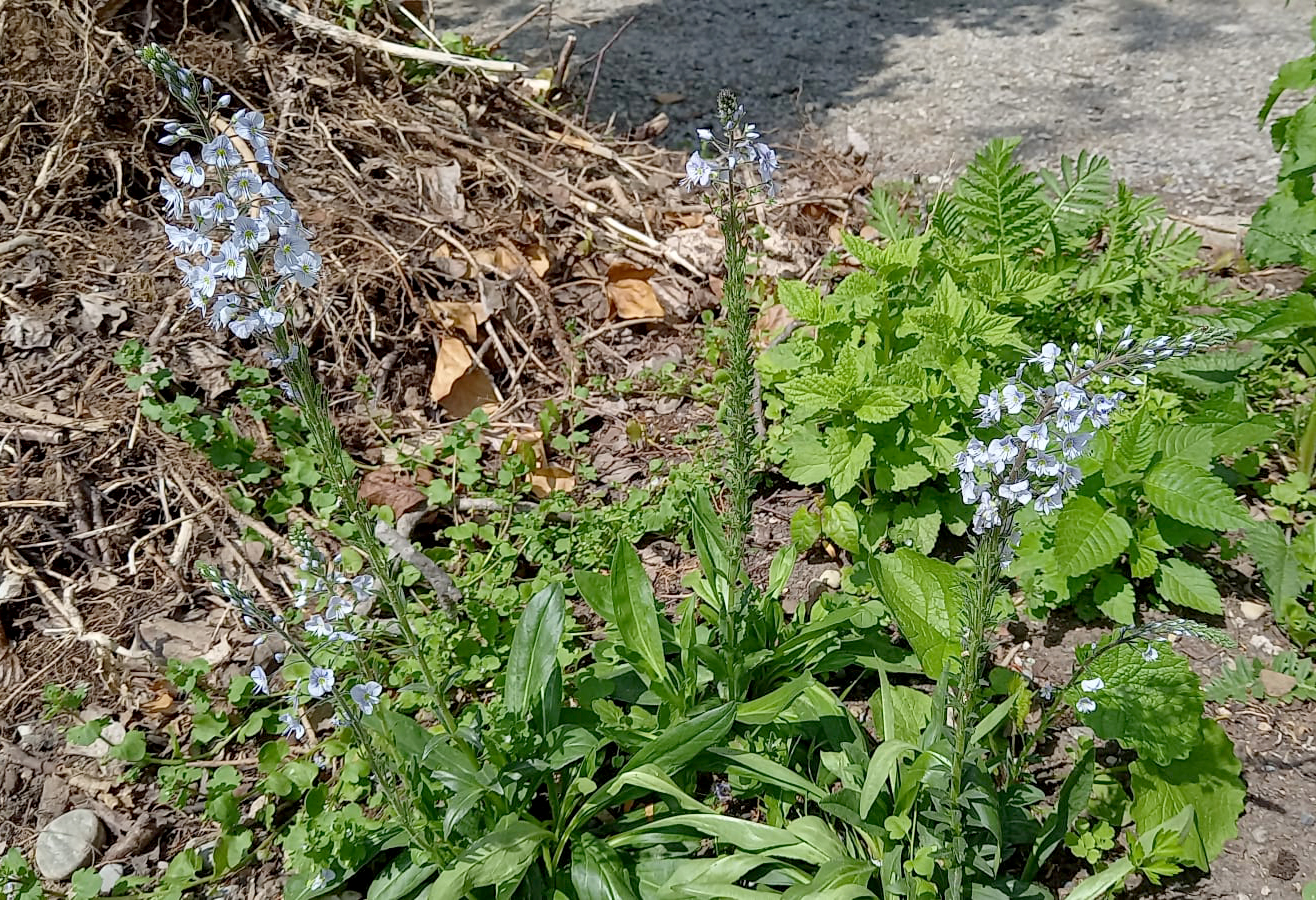
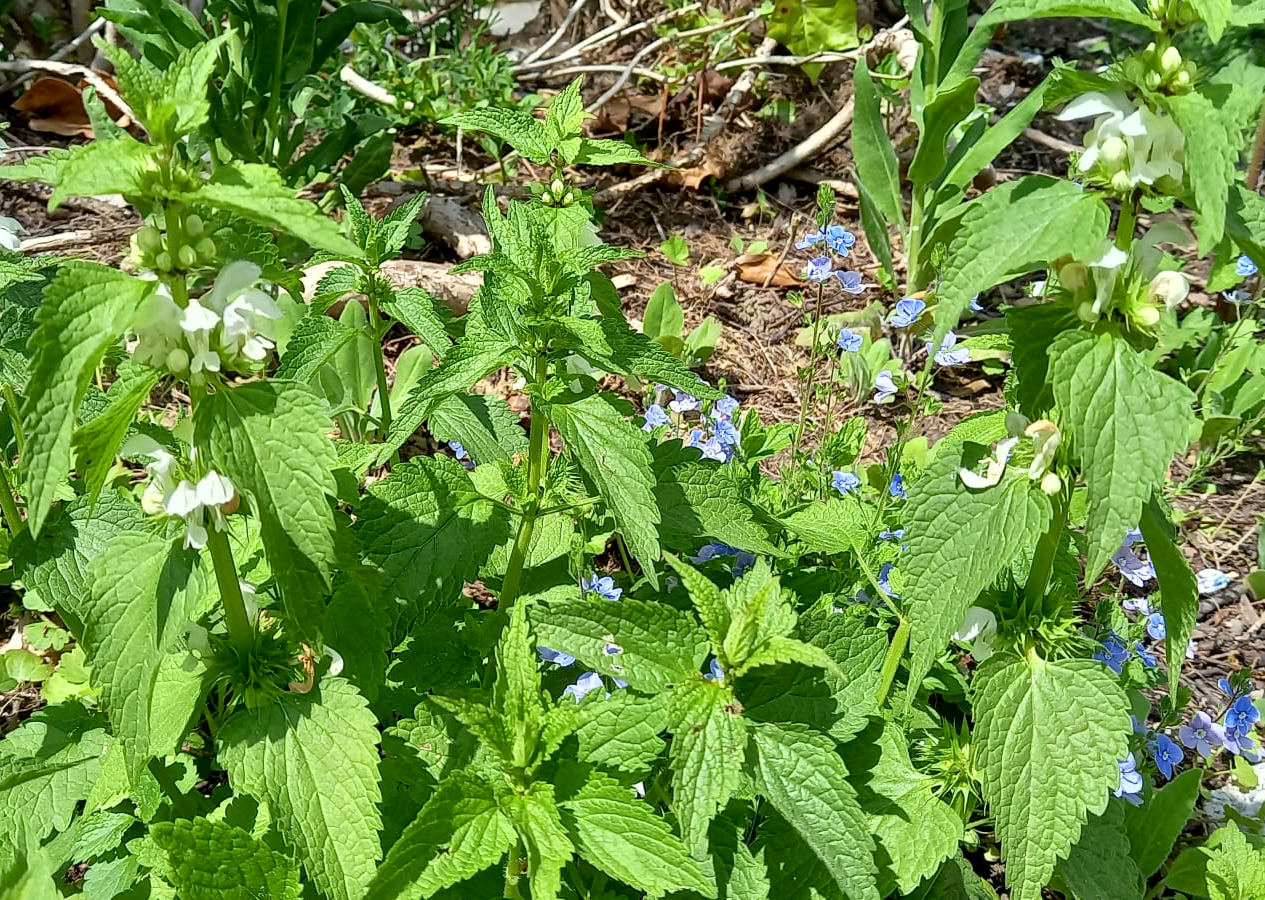
…the first flowers appear. (Photos: Sebastian Wagener)
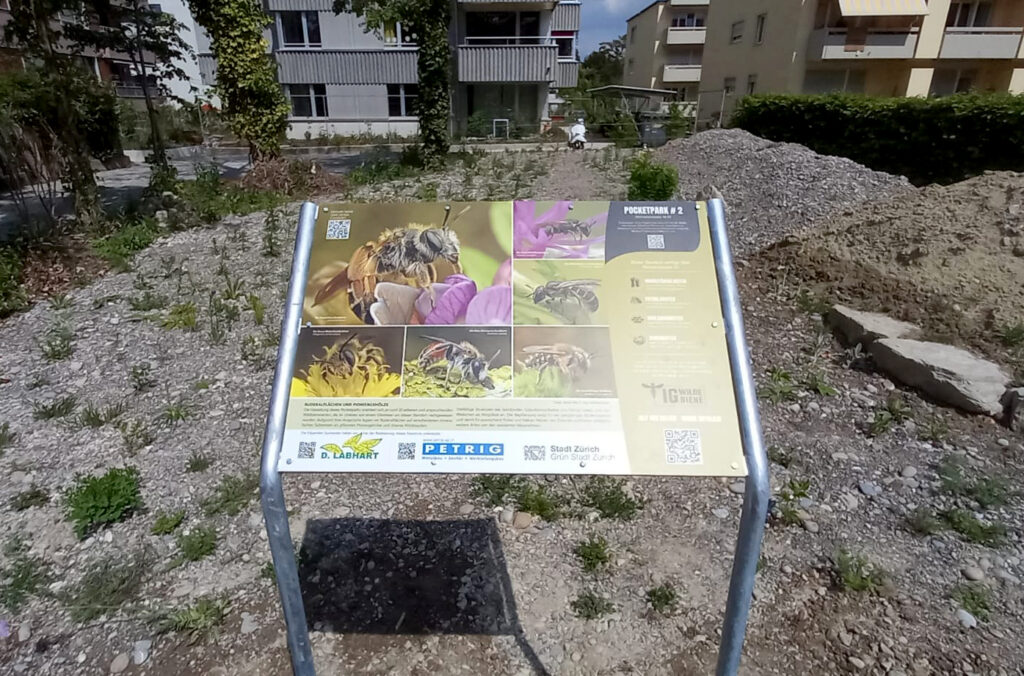
Spring 2022: The crowning touch of the improvement work – the information panel is up! (Photo: Sebastian Wagener)
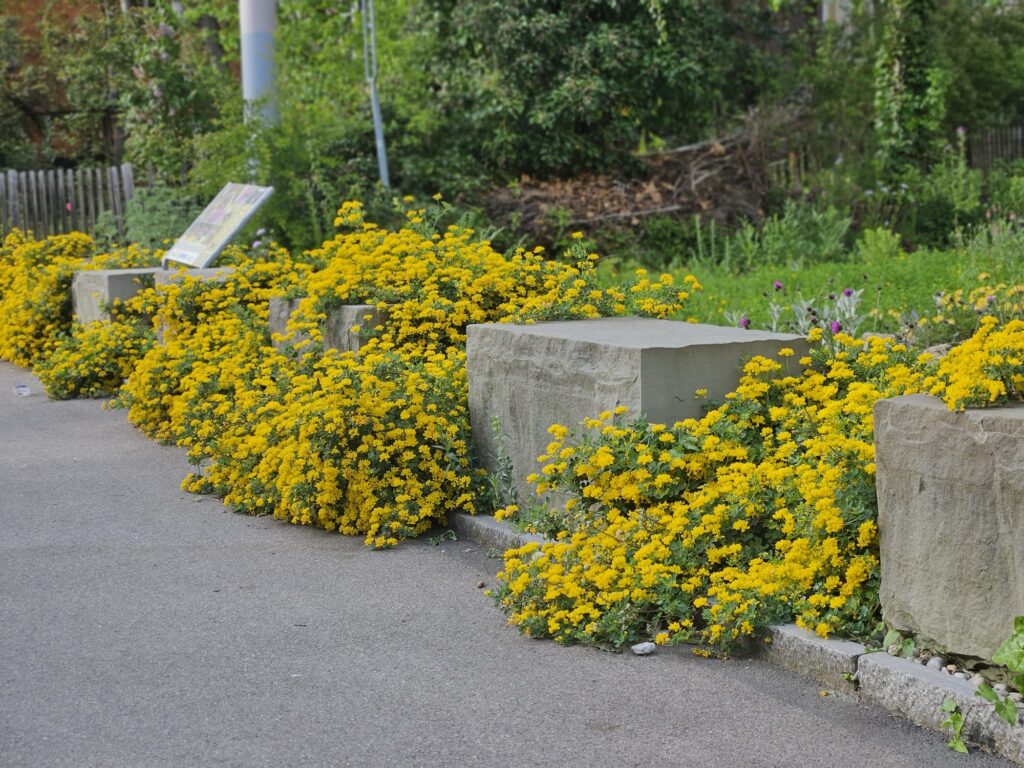
April 2024: Flowering begins (photo: Sebastian Wagener)
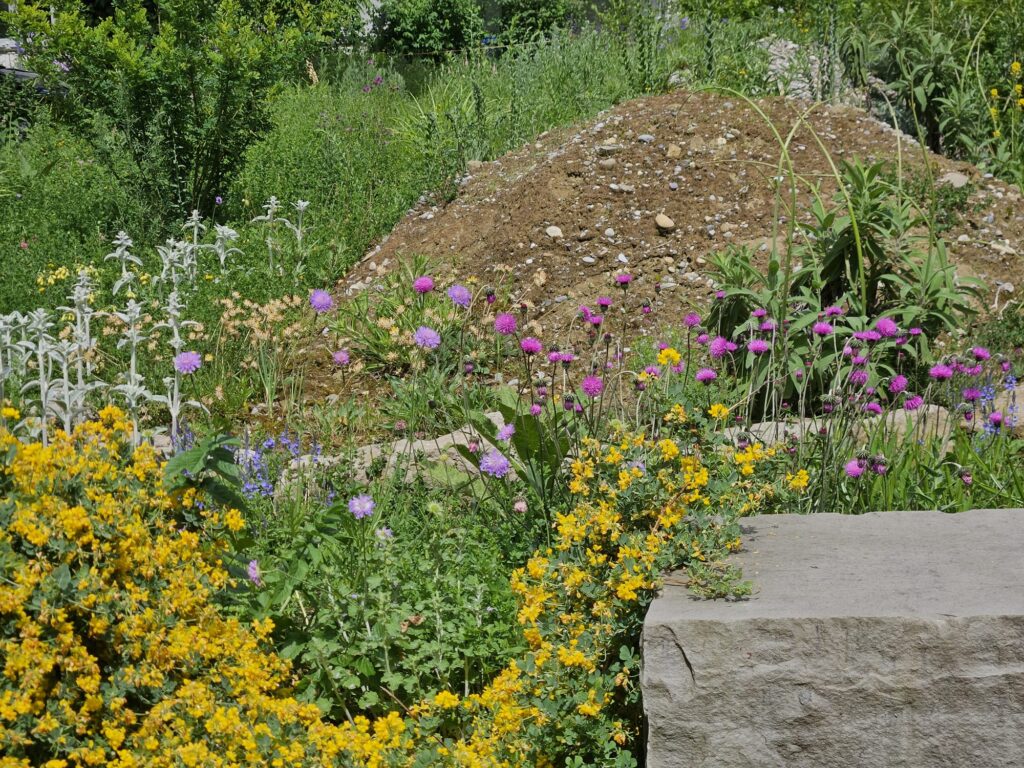
May 2024: Abundance and diversity of flowers are increasing. The loess mound, deliberately kept sparsely vegetated and therefore largely bare, offers numerous ground-nesting species an ideal place to nest. (Photo: Sebastian Wagener)
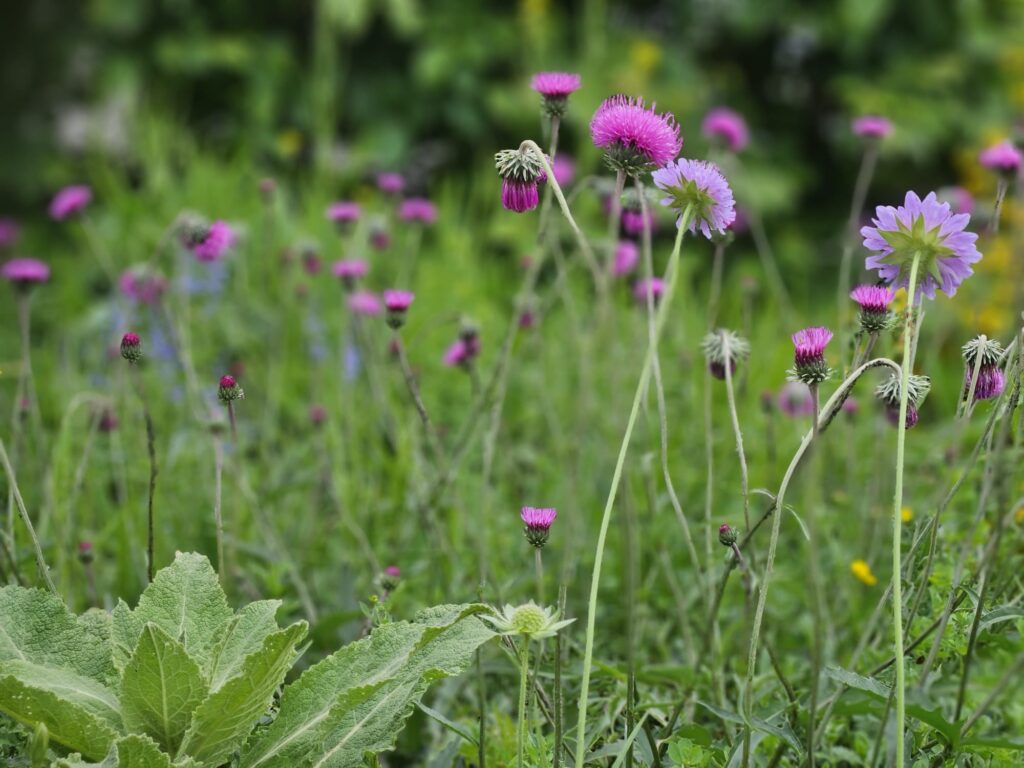
May 2024 (photo: Sebastian Wagener)
Partners
The upkeep of the Zurich pocket parks is made possible by Daniel Labhart from Schafisheim in the canton of Aargau. This innovative horticultural entrepreneur has a genuine commitment to biodiversity and supports the work of IG Wilde Biene through the sale of his planting bricks optimised for wild bees.
Petrig AG in Volketswil supports us with custom-made, weatherproof mounts for the information panels of at least the first 20 pocket parks.
And Grün Stadt Zürich lets us use the city's small parks rent-free and bears the cost of the improvement measures.