The number of actors and measures for protecting the diversity of species is large – commitment of that kind has become a trend. One popular and widely accepted approach is supporting honey bees. Like every trend, however, this one too deserves a critical look. The question arises at what point a well-meant and apparently green solution contributes to ecological problems rather than solving them.
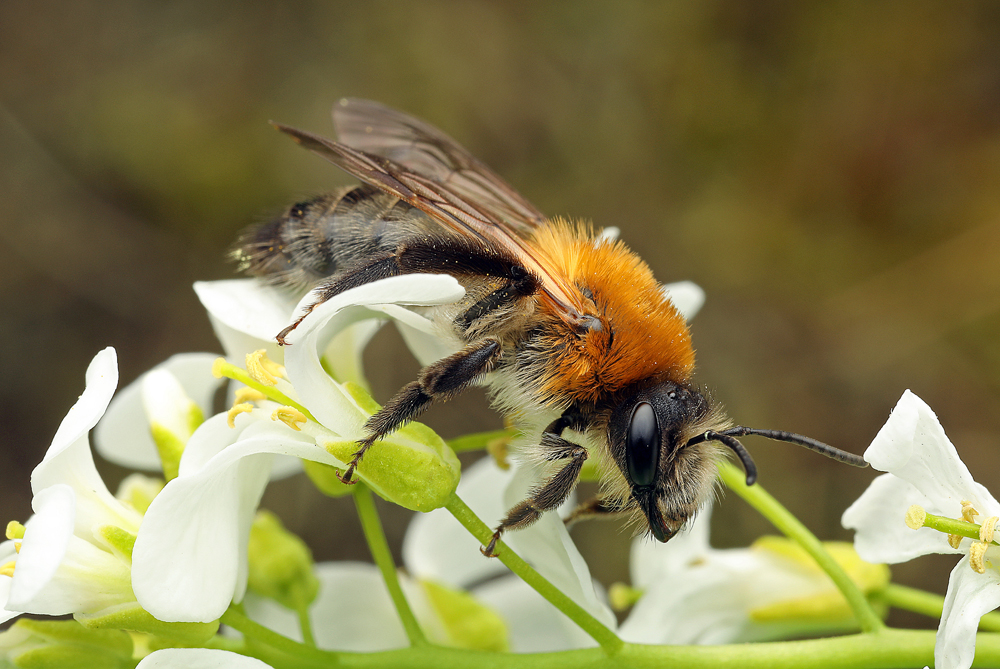
Photo: Andrena nitida is a widespread, unspecialised wild bee. The picture shows a male. (Photo: © Jürg Sommerhalder)
Support for honey bees and the loss of biodiversity
Besides commercial beekeepers, many private individuals keep bees today [1]. Companies [2][3][4] and political parties [5] also try to make their image greener with the help of the popular honey bee and therefore support projects to promote honey bees. In some places this causes the density of honey bees to rise rapidly, already reaching levels [6] that clearly have the potential to disturb the ecological balance – and thus to contribute to a further decline in the diversity of species [7] [8].
Competition
Experts have long feared that honey bees and wild bees might compete with one another. More and more studies therefore examine the effects of high honey bee densities on the local wild bee fauna. Many results indicate clearly that a high density of honey bees:
- leads to competition for food resources between honey bees and wild bees [9][10][11][12][13][14][15][16][17][18][19][20][21][22][23][24][25][26]
- displaces wild bees [10][11][12][13][20][22][23][24][25][26][27]
- can reduce the number and fitness of wild bee offspring [17][23][24][28][29] and
- encourages the transmission of diseases from honey bees to wild bees [19][30][31].
Already today almost half of the 616 [32][33] wild bee species recorded for Switzerland are considered threatened or extinct [34]. The long-term consequences of this decline can be extremely problematic: wild bees are among the most important animal pollinators of wild and cultivated plants [35][36]. They therefore count among the key species in terrestrial ecosystems and contribute substantially to the diversity of species [37][52][53].
Absence of regulation
Some cantons have already recognised the problem of the influence of high honey bee densities on the environment. In the nature reserves of the cantons of Bern [38] and Zurich [39], for example, permits are no longer granted for setting up honey bee apiaries. A regulation of this kind for the whole of Switzerland, however, is still awaited. And even in the two pioneering cantons named, sensible buffer zones for the effective protection of nature reserves are lacking: the flight radius of honey bees can be three kilometres and more [40]. It is therefore well above the diameter of most protected areas in the Canton of Zurich; despite the ban, these are thus in fact barely protected.
The highest honey bee densities today are reached in cities [41]. In the city of Zurich, according to the cantonal veterinary office, the number of beekeepers’ apiaries has risen by 80% since 2014 [42]. As zones free of pesticides, rich in structure and diverse in flowers, settled areas are important habitats and often show an impressive diversity of wild bees. Many rare and threatened wild bee species can be observed in cities [43] [44]. For this reason it seems particularly problematic that keeping honey bees in urban areas is regulated just as little as in classic zones with flora and fauna worth protecting.
Under current practice, honey bee apiaries and colonies need only be reported to the relevant veterinary office. That office does not check for any restrictions applying at the place concerned. Regulation according to quantitative and qualitative criteria is therefore absent [44]. Moreover, the duty to report is ignored by some beekeepers and not enforced by the authorities [45].
False perceptions, misleading campaigns and a lack of information
Keeping honey bees is understood as a measure to support biodiversity, and also as an important contribution to maintaining security of pollination and of food supply. Numerous studies show, however, that the part played by honey bees in pollinating wild and cultivated plants is mostly overestimated [46][47][48][49].
The highest agricultural yields are in fact achieved with the greatest possible diversity of natural pollinators [36][47]. Too high a density of honey bees therefore has a counterproductive effect in agricultural ecosystems as well, and thus economically [50][51].
Campaigns to promote honey bees that rest on scientifically untenable claims accordingly mislead the public, push effective measures for protecting the diversity of species and securing pollination into the background, and tie up valuable resources in projects that achieve little. Reticent or absent efforts to inform people further this development.
Making use of the potential
IG Wilde Biene is convinced that, through scientifically sound information, work to inform the public and targeted measures, a reversal of the trend towards an environment once again richer in species and healthier is possible.
REFERENCES
[1] Charrière J.D., Frese S. & Herren P. 2018. Bienenhaltung
in der Schweiz. Agroscope Transfer 250: 24 S.
[2] https://www.mobiliar.ch/die-mobiliar/engagement/unsere-haltung/mobees-bei-der-mobiliar-bienen-im-einsatz-fuer-die-zukunft
[3] https://www.swisscom.ch/de/about/unternehmen/nachhaltigkeit/bienen.html
[4] https://www.heutefuermorgen.ch/de/projekte/bienen/aldi-suisse-bienenhaeuser.html
[5] https://www.fdp-zh.ch/news-pool/wir-machen-biodiversitaet?id=53941
[6] Schriftliche Mitteilungen des Veterinäramts Zürich (Februar 2020)
[7] Burger R. 2018. Wildbienen first – unsere wichtigsten Bestäuber und die Konkurrenz mit dem Nutztier Honigbiene. Naturkunde aus dem Südwesten 1 (2018): 7 S.
[8] Burkle L.A., Marlin J.C. &Knight T.M. 2013: Plant-Pollinator Interactions over 120 Years: Loss of Species, Co-Occurrence, and Function. Science 339: 1611–1615.
[9] Geldmann J. & González-Varo J.P. 2018. Conserving honey bees does not help wildlife; high densities of managed honey bees can harm populations of wild pollinators. Science 359 (6374): 392–393.
[10] Henry M. & Rodet G. 2018. Controlling the impact of the managed honeybee on wild bees in protected areas. Scientific Reports 8: 10 pp. doi: 10.1038/s41598-018-27591-y
[11] Goulson D., Stout J.C. & Kells A.R. 2002. Do exotic bumblebees and honeybees compete with native flower-visiting insects in Tasmania? Journal of Insect Conservation 6: 179–189.
[12] Gross C.L. 2001. The effect of introduced honeybees on native bee visitation and fruit-set in Dillwynia juniperina (Fabaceae) in a fragmented ecosystem. Biological Conservation 102 (1): 89–95.
[13] Schaffer W.M., Zeh D.W., Buchmann S.L., Kleinhans S., Schaffer M.V. & Antrim J. 1983. Competition for nectar between introduced honey bees and native North American bees and ants. Ecology 64 (3): 564–577.
[14] Cane J.H. & Tepedino V.J. 2017. Gauging the Effect of Honey Bee Pollen Collection on Native Bee Communities. Conservation Letters 10 (2): 205–210. doi.org/10.1111/conl.12263
[15] Geslin B., Gauzens B., Baude M., Dajoz I., Fontaine, C., Henry M., Ropars L., Rollin O., Thébault E. & Vereecken N.J. 2017. Massively Introduced Managed Species and Their Consequences for Plant–Pollinator Interactions. Advances in Ecological Research 57: 147–199. doi.org/10.1016/bs.aecr.2016.10.007
[16] Torné-Noguera A., Rodrigo A., Osorio S. & Bosch J. 2016. Collateral effects of beekeeping: Impacts on pollen-nectar resources and wild bee communities. Basic and Applied Ecology 17 (3): 199–209.
[17] Goulson D. & Sparrow K. 2008: Evidence for competition between honeybees and bumblebees; effects on bumblebee worker size. Journal of Insect Conservation. 13 (2): 177–181.
[18] Requier F., Odoux J-F., Tamic T., Moreau N., Henry M., Decourtye A. & Bretagnolle V. 2015. Honey bee diet in intensive farmland habitats reveals an unexpectedly high flower richness and a major role of weeds. Ecological Applications 25 (4): 881–890.
[19] Mallinger R.E., Gaines-Day H.R. & Gratton C. 2017. Do managed bees have negative effects on wild bees?; a systematic review of the literature. Plos One 12 (12): 32 pp. doi.org/10.1371/journal.pone.0189268
[20] Ropars L., Dajoz I., Fontaine C., Muratet A. & Geslin B. 2019. Wild pollinator activity negatively related to honey bee colony densities in urban context. Plos One 14 (9): 16 pp. doi.org/10.1371/journal.pone.0222316
[21] Shavit O., Dafni A. & Ne’eman G. 2009. Competition between honeybees (Apis mellifera) and solitary bees in the Mediterranean region of Israel; implications for conservation. Israel Journal of Plant Sciences 57: 171–183.
[22] Valido A., Rodríguez-Rodríguez M.C. & Jordano P. 2019. Honeybees disrupt the structure and functionality of plant-pollinator networks. Scientific Reports 9: 11 pp. doi.org/10.1038/s41598-019-41271-5
[23] Evertz S. 1993. Untersuchungen zur interspezifischen Konkurrenz zwischen Honigbienen (Apis mellifera L.) und solitären Wildbienen (Hymenoptera, Apoidea). unpubl. Dissertation, Technische Hochschule Aachen. 123 S.
[24] Evertz S. 1995. Interspezifischen Konkurrenz zwischen Honigbienen (Apis mellifera) und solitären Wildbienen (Hymenoptera, Apoidea). Natur und Landschaft 70: 165–172.
[25] Thomson D.M. 2006. Detecting the effects of introduced species: A case study of competition between Apis and Bombus. Oikos 114: 407–418.
[26] Walther-Hellwig K., Fokul G., Frankl R., Büchler R., Ekschmitt K. & Wolters V. 2006. Increased density of honeybee colonies affects foraging bumblebees. Apidologie 37: 517–532. doi: 10.1051/apido:2006035
[27] Henry M. & Rodet G. 2018. Controlling the impact of the managed honeybee on wild bees in protected areas. Scientific Reports 8: 10 pp. doi: 10.1038/s41598-018-27591-y
[28] Thomson D. 2004. Competitive interactions between the invasive European honey bee and native bumble bees. Ecology 85: 458-470.
[29] Goodell K. 2000. The impact of honey bees on native solitary bees: Competition and indirect effects. PhD thesis. New York, State University of New York, Stony Brook.
[30] Alger S.A., Burnham P.A., Boncristiani H.F. & Brody A.K. 2019. RNA virus spillover from managed honeybees (Apis mellifera) to wild bumblebees (Bombus sp.). Plos One 14 (6): 9 pp. doi.org/10.1371/journal.pone.0217822
[31] Fürst M.A., McMahon D.P., Osborne J.L., Paxton R.J., Brown M.J.F. 2014. Disease associations between honeybees and bumblebees as a threat to wild pollinators. Nature 506: 364–366. doi: 10.1038/nature12977
[32]Pfiffner L. & Müller A. 2016. Wildbienen und Bestäubung. Faktenblatt FIBL 1633: 8 S.
[33] info fauna – Centre Suisse de Cartographie de la Faune (CSCF)
[34] Amiet F. 1994. Rote Liste der gefährdeten Bienen der Schweiz. In Duelli P. (Red.): Rote Listen der gefährdeten Tierarten in der Schweiz. BUWAL (Hrsg.), EDMZ (Vertrieb), Bern. S. 38–44.
[35] Michener, C.D. 2007. The bees of the world (second edition). Johns Hopkins Univ. Press, Baltimore. 992 pp.
[36] Garibaldi L.A., Steffan-Dewenter I., Winfree R., Aizen M.A., Bommarco R., Cunningham S.A., Kremen C., Carvalheiro L.G., Harder L.D., Afik O., Bartomeus I., Benjamin F., Boreux V., Cariveau D., Chacoff N.P., Dudenhöffer J.H., Freitas B.M., Ghazoul J., Greenleaf S., Hipólito J., Holzschuh A., Howlett B., Isaacs R., Javorek S.K., Kennedy C.M., Krewenka K.M., Krishnan S., Mandelik Y., Mayfield M.M., Motzke I., Munyuli T., Nault B.A., Otieno M., Petersen J., Pisanty G., Potts S.G., Rader R., Ricketts T.H., Rundölf M., Seymour C.L., Schüepp C., Szentgyörgyi H., Taki H., Tscharntke T., Vergara C.H., Viana B.F., Wanger T.C., Westphal C., Williams N. & Klein A.M. 2013. Wild pollinators enhance fruit set of crops regardless of honey bee abundance. Science 339: 1608–1611.
[37] Kratochvil A. 2003. Bees as key-stone species; specifics of resource and requisite utilization in different habitat types. Berichte der Reinhold-Tüxen-Gesellschaft 15: 59–77.
[38] Merkblatt Bienenvölker in Naturschutzgebieten 2018. Abteilung für Naturförderung, Kanton Bern.
[39] Schriftliche Mitteilung (2020, E-Mail) Martin Graf, Amt für Landschaft und Natur, Fachstelle Naturschutz, Kanton Zürich.
[40] Ribbands C.R. 1951. The Flight Range of the Honey-Bee. Journal of Animal Ecology, 20 (2): 220–226.
[41] von Büren R.S., Oehen B., Kuhn N.J. & Erler S. 2019. High-resolution maps of Swiss apiaries and their applicability to study spatial distribution of bacterial honey bee brood diseases. PeerJ 7: 21 pp. doi.org/10.7717/peerj.6393
[42] Schriftliche Mitteilung (2020, Email) Urte Hinrichs, Veterinäramt, Gesundheitsdirektion, Kanton Zürich.
[43] Zurbuchen A., Müller A. 2012. Wildbienenschutz – von der Wissenschaft zur Praxis. Bristol-Schriftenreihe 33: 162 S.
[44] Schriftliche Mitteilungen des Veterinäramts Zürich (Februar 2020)
[45] Persönliche Mitteilung (2019) verschiedener ImkerInnen, bspw. Christine Cariget und Doris Allrich.
[46] Breeze T.D., Bailey A.P., Balcombe K.G. & Potts S.G. 2011. Pollination services in the UK: how important are honeybees. Agriculture, Ecosystems and Environment 142: 137–143.
[47] Garibaldi, L.A., Steffan-Dewenter, I., Winfree, … & Klein, A.M. 2013. Wild pollinators enhance fruit set of crops regardless of honey bee abundance. Science, 339, 1608-1611.
[48] Eeraerts M., Vanderhaegen R., Smagghe G. & Meeus I. 2020. Pollination efficiency and foraging behaviour of honey bees and non‐Apis bees to sweet cherry. Agricultural and Forest Entomology 22 (1): 75–82.
[49] Holzschuh A., Dudenhöffer J.-H. & Tscharntke T. 2012. Landscapes with wild bee habitats enhance pollination, fruit set and yield of sweet cherry. Biological Conservation 153: 101–107.
[50] Sáez A., Morales C.L., Ramos L.Y. & Aizen M.A. 2014. Extremely frequent bee visits increase pollen deposition but reduce drupelet set in raspberry. Journal of Applied Ecology 51: 1603–1612.
[51] Rollin O. & Garibaldi L.A. 2019. Impacts of honeybee density on crop yield: A meta‐analysis. Journal of Applied Ecology 56: 1152–1163.
[52] Ollerton J., Winfree R. & Tarrant S. 2011. How many flowering plants are pollinated by animals? Oikos 120 (3): 321–326.
[53] Peters R.S., Krogmann L., Mayer C., Donath A., Gunkel S., Meusemann K., Kozlov A., Podsiadlowski L., Petersen M., Lanfear R., Diez P.A., Heraty J., Kjer K.M., Klopfstein S., Meier R., Polidori C., Schmitt T., Liu S., Zhou X., Wappler T., Rust J., Misof B. & Niehuis O. 2017. Evolutionary History of the Hymenoptera. Current Biology 27 (7): 1013–1018 + Suppl. Inf.