Insects are the most important pollinators of flowering plants and thereby provide an enormous economic and ecological benefit for people and for nature.
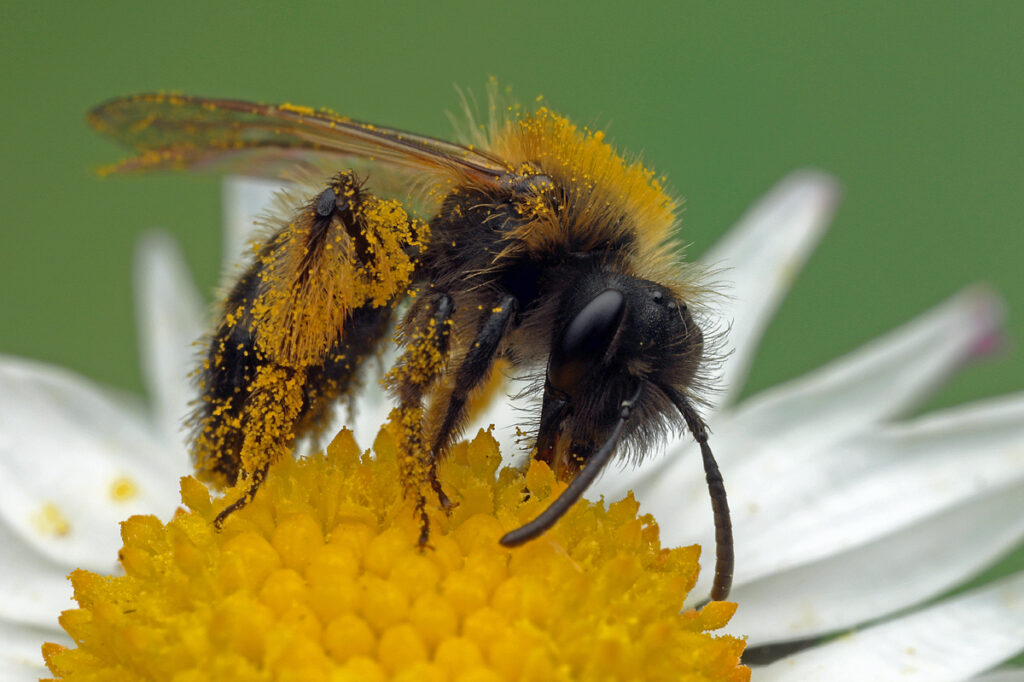
Photo: A female of the grey-gastered mining bee (Andrena bicolor) at work pollinating. (Photo: © Jürg Sommerhalder)
“Bee diversity” is the magic word
The economic value of pollination in food production is estimated worldwide at 153 billion euros a year [14]; of the 109 most important crop plants worldwide, no fewer than 87 depend entirely on animal pollinators [19], and 78 per cent of all flowering plant species of the temperate zones depend on insects for their pollination [21]. Although wind-pollinated crops such as cereals account for 60 per cent of total annual production volume [14], certain insect-pollinated fruits and vegetables are worth five times as much per tonne and thus rank among the economically most interesting foods [2] [14].
Bees are regarded as the most important group of pollinators among the insects [20]. The part played by the other insect pollinators, such as flies, beetles, wasps or butterflies, has however probably been underestimated so far: 25 to 50 per cent of all flower visits are likely to be down to these non-bee pollinators, though their efficiency as carriers of pollen is mostly markedly lower than that of bees [23]. Bees owe their central importance as pollinators of flowers not only to the fact that, with 20,000 to 30,000 species worldwide, they are decidedly rich in species and occur at high densities in many habitats, but above all to the fact that, alongside the species-poor pollen wasps, they are the only flower visitors that depend entirely on the products of flowers not only for their own food but also for their reproduction. To collect sufficiently large quantities of pollen and nectar to feed their larvae, bees must therefore visit flowers markedly more often than other groups of pollinators.
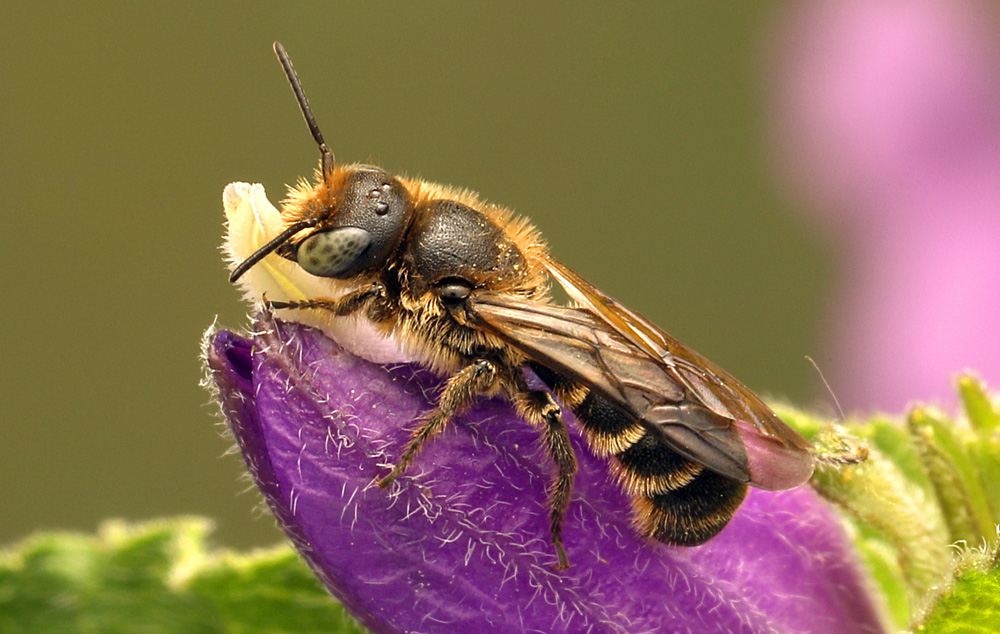
Photo: The harebell carpenter bee (Chelostoma rapunculi, a male in the picture) is a specialist that collects pollen exclusively from bellflowers (Campanulaceae) (Photo: © André Rey)
Apis mellifera – the honey bee
In central Europe the honey bee is regarded as a particularly important pollinator of cultivated and wild plants. Its colonies contain up to several tens of thousands of workers, active from early spring until late in the autumn. As a pronounced generalist, the honey bee uses a very wide range of flowers, but often develops a temporary flower constancy, which raises the likelihood of successful pollination [11]. Its ability to communicate the precise position of good sources of food by means of the dance language allows favourable food sources to be used in a targeted and efficient way [16] [22]. These characteristics, typical of the honey bee, explain the high economic value of the pollination it provides, put at at least three billion euros a year in Germany and around 260 million francs in Switzerland [9] [10].
Honey bees overestimated, wild bees underestimated
The honey bee is only one of close to 2,100 bee species native to Europe [1], and in Switzerland alone more than 600 further bee species occur alongside the honey bee. Depending on the geographical region, weather conditions or flower structure, these wild bees can be equal, more efficient or even the sole pollinators of particular flowering plants compared with the honey bee [12] [13] [26]. Bumblebees, and several mining and mason bees that fly early in the year, are still active in cool weather when honey bee workers no longer leave the hive. They accordingly play a substantial part in pollinating fruit, for example, during longer spells of poor weather [24] [28]. Flowers with deeply hidden nectar such as red clover or monkshood, with a complicated structure such as lousewort, with explosive pollen presentation such as lucerne, or with poisonous pollen such as buttercup, are barely visited by the honey bee. The same is true of many members of the nightshade and borage families, whose flowers can only be exploited by a special technique, so-called buzz pollination, which the honey bee has not mastered [12] [28]. All of these plants avoided by the honey bee are pollinated by various wild bee species [28]. Because honey bee workers, unlike wild bees, do not collect nectar and pollen at the same time during a flower visit, and avoid contact with the anthers while taking nectar, honey bees are often not very efficient pollinators [27] [29]. Compared with the honey bee, females of the mason bee Osmia cornuta visit more flowers per unit of time, come into contact with the stigmas markedly more often and fly at lower levels of radiation and temperature, making them the markedly more efficient pollinators of fruit, for example [3] [25] . Fewer than 1,000 female mason bees are thus enough to pollinate one hectare of apple orchard successfully, whereas up to two and a half strong honey bee colonies with several tens of thousands of workers are needed for the same area of fruit [4] [7] [25]. At the level of the individual, wild bees can therefore be up to a hundred times more efficient as pollinators than the honey bee.
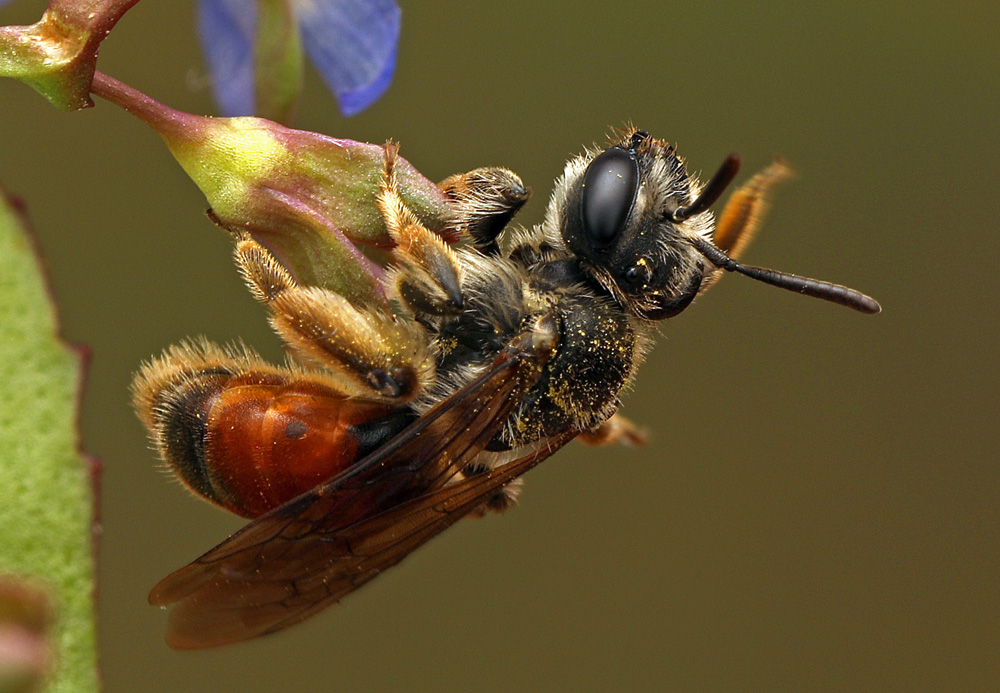
Photo: Contrary to its German name, Andrena labiata is not choosy: although it is often found on speedwell flowers (genus Veronica), it collects pollen from numerous plant families. It flies from April to July and is among the species not currently threatened. (Photo: female, © André Rey)
These examples make clear that the honey bee cannot act as the sole pollinator in central European ecosystems, and that wild bees too have a large and long strongly underestimated part to play as pollinators. The pollination provided by the honey bee, to which up to 80 per cent of global pollination services in agricultural crops has been ascribed [8], is in fact likely to have been greatly overestimated. The entire honey bee population resident in Great Britain in 2007 covered at most a third of the total pollination of agricultural crops; the rest was down to wild pollinators, in particular wild bees and hoverflies [5]. A large-scale study that compared the pollination provided by honey bees and by wild pollinators in more than 40 crops worldwide came to a similar conclusion [15]. That study found i) that the honey bee visitation rate had a positive influence on fruit set in only 14% of the crops, ii) that wild pollinators – above all wild bees and hoverflies – contributed significantly to fruit set in all crops, and did so even where the honey bee was common, and iii) that an increase in the wild pollinator visitation rate led to twice as high a fruit set as an equivalent increase in the honey bee visitation rate. In cherry too, wild bees proved the more important pollinators compared with the honey bee, even though two thirds of all flower visitors were honey bees [17].
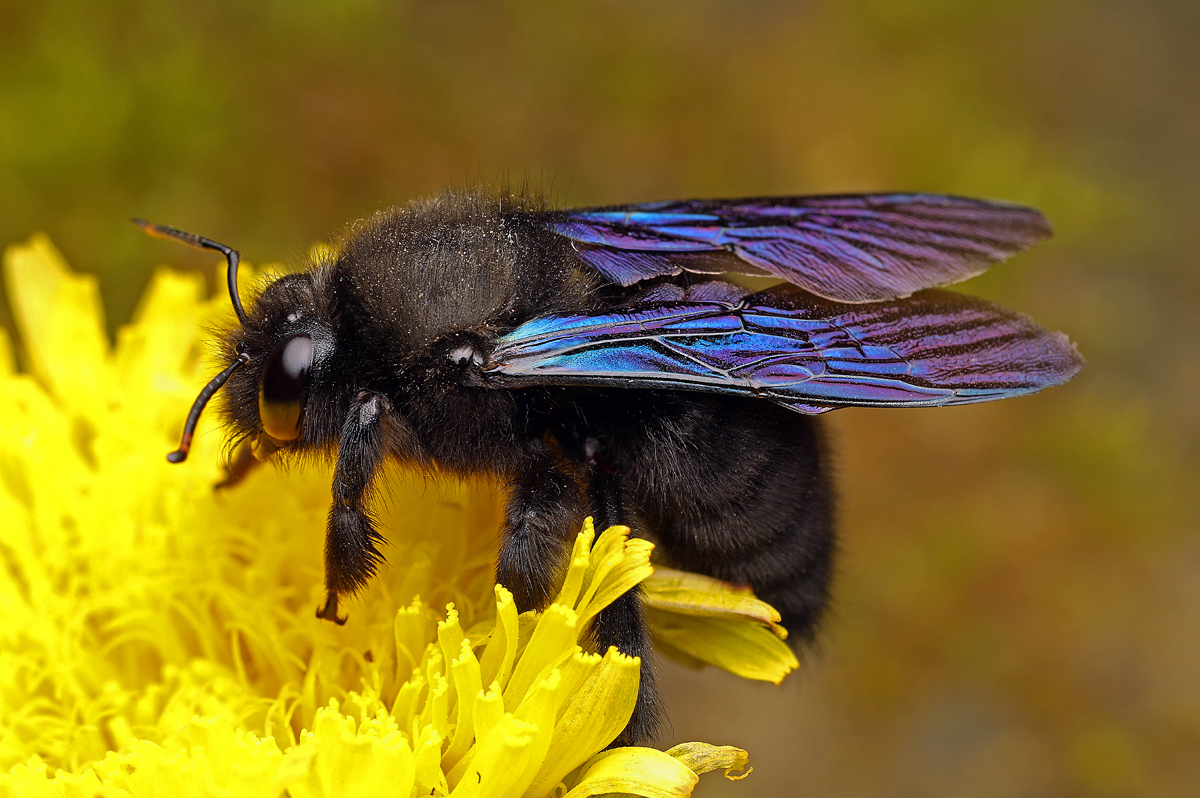
Photo: The violet carpenter bee (Xylocopa violacea) is one of the largest native wild bee species. It overwinters as an adult bee and appears very early in the year when the weather allows. The male pictured could be photographed on a dandelion flower on a warm February day. (Photo: © Jürg Sommerhalder)
High efficiency through diversity
The large part played by wild bees as pollinators of flowers rests – besides their often high efficiency as carriers of pollen – chiefly on their great diversity of species, which shows itself in quite different sizes and hairiness, different patterns of activity through the day, varying sensitivity to unfavourable weather and differing behaviour when visiting flowers. Hence the simple rule: the more different bee species visit the flowers of a plant species, the higher the likelihood that the pollen will be transferred successfully. Several studies do indeed show that the proportion of fertilised flowers depends less on the number of bee individuals than on the number of different bee species. In blueberry, for example, raising the honey bee density brought no improvement in fruit set, whereas raising the diversity of wild bee species did [6]. Or again: with twenty different flower-visiting bee species, 90 per cent of all coffee flowers proved to be fertilised, while with three species the proportion of fertilised flowers was only 60 per cent [18].
Securing the pollination of wild and cultivated plants in the long term, in ecosystems close to nature as well as in those influenced by people, therefore calls not only for the honey bee but also for a wild bee fauna rich in species. Just as the honey bee cannot be dispensed with as a pollinator in cleared landscapes poor in wild bees, so across large parts of our landscape we cannot manage without a wild bee fauna rich in both species and individuals.
Summary
- Bees are regarded as the most important group of pollinators among the insects.
- Bees owe their central importance as pollinators of flowers above all to the fact that they are the only flower visitors that depend entirely on the products of flowers for their reproduction as well, and must accordingly visit flowers often in order to collect sufficiently large quantities of pollen and nectar to feed their larvae.
- The pollination provided by the honey bee was for a long time greatly overestimated.
- Depending on the geographical region, weather conditions or flower structure, wild bees can be equal, more efficient or even the sole pollinators of particular flowering plants compared with the honey bee.
- The large part played by wild bees as pollinators of flowers rests, besides their often high efficiency as carriers of pollen, chiefly on their great diversity of species.
- The simple rule applies: the more different bee species visit the flowers of a plant species, the higher the likelihood that the pollen will be transferred successfully.
- Securing the pollination of wild and cultivated plants in the long term calls not only for the honey bee but also for a wild bee fauna rich in species.
References
[1] Ascher, J.S. & Pickering, J. (2019): Discover Life bee species guide and world checklist (Hymenoptera: Apoidea: Anthophila). http://www.discoverlife.org/mp/20q?guide=Apoidea_species
[2] Ashworth, L., Quesada, M., Casas, A., Aguilar, R. & Oyama, K. (2009): Pollinator-dependent food production in Mexico. Biological Conservation, 142, 1050-1057.
[3] Bosch, J. & Blas, M. (1994): Foraging behaviour and pollination efficiency of Osmia cornuta and Apis mellifera on Almond (Hymenoptera, Megachilidae and Apidae). Applied Entomology and Zoology, 29, 1-9.
[4] Bosch, J. & Kemp, W. (2001): How to manage the blue orchard bee as an orchard pollinator. Sustainable Agriculture Network Handbook Series, 5.
[5] Breeze, T.D., Bailey, A.P., Balcombe, K.G. & Potts, S.G. (2011): Pollination services in the UK: how important are honeybees. Agriculture, Ecosystems and Environment, 142, 137-143.
[6] Button, L. & Elle, E. (2014): Wild bumble bees reduce pollination deficits in a crop mostly visited by managed honey bees. Agriculture, Ecosystems and Environment, 197, 255-263.
[7] Calzoni, G.L. & Speranza, A. (1998): Insect controlled pollination in Japanese plum (Prunus salicina). Scientia Horticulturae, 72, 227-237.
[8] Carreck, N. & Williams, I. (1998): The economic value of bees in the UK. Bee world, 79, 115-123.
[9] Fluri, P. & Frick, R. (2005): L’apiculture en Suisse: état et perspectives. Revue Suisse d’Agriculture, 37, 81-86.
[10] Fluri, P., Schenk, P. & Frick, R. (2004): Bienenhaltung in der Schweiz. Zentrum für Bienenforschung Liebefeld-Poisieux, ALP Forum 8D, 1-51.
[11] Free, J.B. (1963): The flower constancy of honeybees. Journal of Animal Ecology, 32, 119-131.
[12] Free, J.B. (1993): Insect pollination of crops. Academic Press, London.
[13] Freitas, B.M. & Paxton, R.J. (1998): A comparison of two pollinators: the introduced honeybee Apis mellifera and an indigenous bee Centris tarsata on cashew Anacardium occidentale in its native range in NE Brazil. Journal of Applied Ecology, 35, 109-121.
[14] Gallai, N., Salles, J.M., Settele, J. & Vaissiere, B.E. (2009): Economic valuation of the vulnerability of world agriculture confronted with pollinator decline. Ecological Economy, 68, 810-821.
[15] Garibaldi, L.A., Steffan-Dewenter, I., Winfree, … & Klein, A.M. (2013): Wild pollinators enhance fruit set of crops regardless of honey bee abundance. Science, 339, 1608-1611.
[16] Goulson, D. (2003): Effects of introduced bees on native ecosystems. Annual Review of Ecology, Evolution and Systematics, 34, 1-26.
[17] Holzschuh, A., Dudenhöffer, J.-H. & Tscharntke, T. (2012): Landscapes with wild bee habitats enhance pollination, fruit set and yield of sweet cherry. Biological Conservation, 153, 101-107.
[18] Klein, A.M., Steffan-Dewenter, I. & Tscharntke, T. (2003): Fruit set of highland coffee increases with the diversity of pollinating bees. Proceedings of the Royal Society London (Biology), 270, 955-961.
[19] Klein, A.M., Vaissière, B.E., Cane, J.H., Steffan-Dewenter, I., Cunningham, S.A., Kremen, C. & Tscharntke, T. (2007): Importance of pollinators in changing landscapes for world crops. Proceedings of the Royal Society London (Biology), 274, 303-313.
[20] Michener, C.D. (2007): The bees of the world. Hopkins, Baltimore.
[21] Ollerton, J., Winfree, R. & Tarrant, S. (2011): How many flowering plants are pollinated by animals? Oikos, 120, 321-326.
[22] Pickhardt, A. & Fluri, P. (2000): Die Bestäubung der Blütenpflanzen durch Bienen – Biologie, Ökologie, Ökonomie. Schweizerisches Zentrum für Bienenforschung Mitteilung Nr. 38.
[23] Rader, R., Bartomeus, I., Garibaldi, L.A., … & Woyciechowski, M. (2016): Non-bee insects are important contributors to global crop pollination. Proceedings of the National Academy of Sciences, 113, 146-151.
[24] Schindler, M. & Peters, B. (2011): Eignen sich die Mauerbienen Osmia bicornis und Osmia cornuta als Bestäuber im Obstbau? Erwerbs-Obstbau, 52, 111-116.
[25] Vicens, N. & Bosch, J. (2000): Pollinating efficacy of Osmia cornuta and Apis mellifera (Hymenoptera: Megachilidae, Apidae) on “Red Delicious” apple. Environmental Entomology, 29, 235-240.
[26] Waser, N.M., Chittka, L., Price, M.V., Williams, N.M. & Ollerton, J. (1996): Generalization in pollination systems, and why it matters. Ecology 77, 1043-1060.
[27] Westerkamp C. (1991): Honeybees are poor pollinators – why? Plant Systematics and Evolution, 177, 71-75.
[28] Westrich, P. (2019): Die Wildbienen Deutschlands. Ulmer, Stuttgart.
[29] Woodcock, B.A., Edwards, M., Redhead, J.W., Meek, W.R., Nuttall, P., Falk, S., Nowakowski, M. & Pywell, R.F. (2013): Crop flower visitation by honeybees, bumblebees and solitary bees: small scale behavioural differences linked to landscape scale responses. Agriculture Ecosystems and Environment, 117, 1-8.