The current Red List of threatened wild bees dates from 1994 and classes close to 50% of native wild bee species as threatened. Wild bee specialists are currently preparing the new edition of this listing on behalf of the FOEN, and the situation is to be expected to have worsened further since 1994.
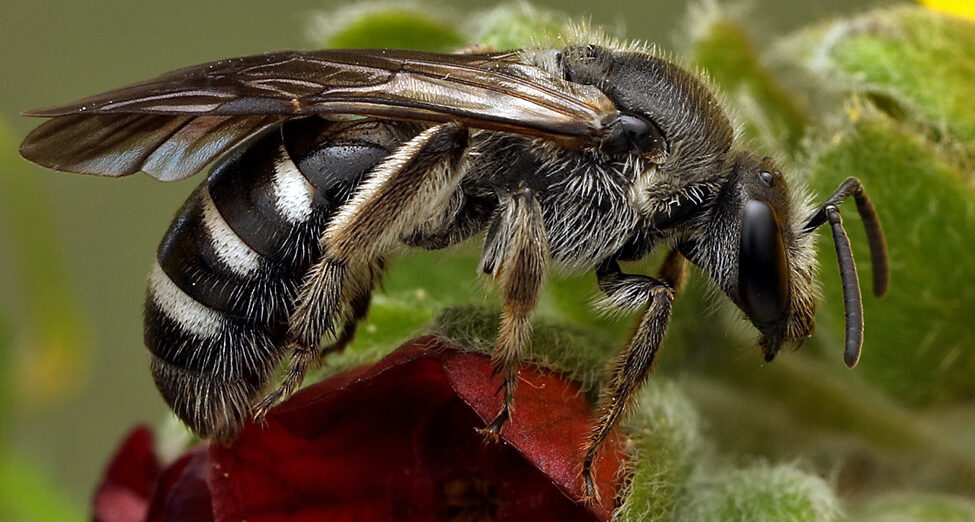
The furrow bee Lasioglossum sexnotatum (a female in the picture) is on the Red List as a threatened species. Although it counts as an unspecialised species – it collects pollen from various plant families – intensive agriculture is making life hard for it: with the disappearance of nutrient-poor meadows and pastures it finds ever fewer nesting opportunities and long ago became a rare species. (Photo: © André Rey)
The much-used term “bee mortality” refers in ordinary usage to a farm animal: the managed honey bee. The decline of wild bees, by contrast, usually attracts little attention and tends to be filed under the collective heading of species extinction. In this article we want to shed light on the causes of the threat to the 616 wild bee species found in Switzerland. They affect not only our wild bees, however, but a great many wild animal and plant species.
The honey bee, a special case
The western honey bee (Apis mellifera) is, in numbers of individuals, the most widely kept farm animal in Switzerland. Its populations suffer from numerous causes connected with the way it is kept, such as a lack of resistance through overbreeding and non-native parasites such as the varroa mite. Alongside these they are also affected by some of the causes that harm wild bees. We shall not go into the causes of the death of managed bees in depth here; that is already being done in full detail elsewhere. Managed bees are hardly likely to become extinct – as is true of every farm animal in human hands. Very few wild-living colonies of the western honey bee remain in Switzerland. For them the same causes of threat apply as for all other wild bees.
Agriculture as a cluster of threats
The flourishing agriculture of the 17th century meant an upturn for the biodiversity of our country. The creation of new, open landscape types, varied and rich in flowers, produced new habitat for numerous plant and animal species.
With the industrialisation of agriculture in the 20th century the opposite effect set in. The classic demands of industrialisation – raising productivity, specialisation, mechanisation, maximising profit – led to a worrying loss of species in farmland.
Some of the many effects of modern agriculture that damage biodiversity:
Monocultures
One third of native wild bees depend on specific plant families, genera or even species. They find no food, or not enough, in farmland given over to monocultures. And even generalists among the wild bees cannot cope with monocultures, because these are either without flowers all year round (maize and wheat crops) or lead to flowerless periods between crop rotations.
 Lack of structure
Most wild bees nest on or in the ground; others need deadwood or pithy plant stems, open sandy soils, banks, heaps of branches, dead plants. Such small structures are missing for wild bees in our tidied-up farmland and forests. Bumblebees rely for their reproduction on abandoned burrows of mice and moles, which farmers likewise fight against.
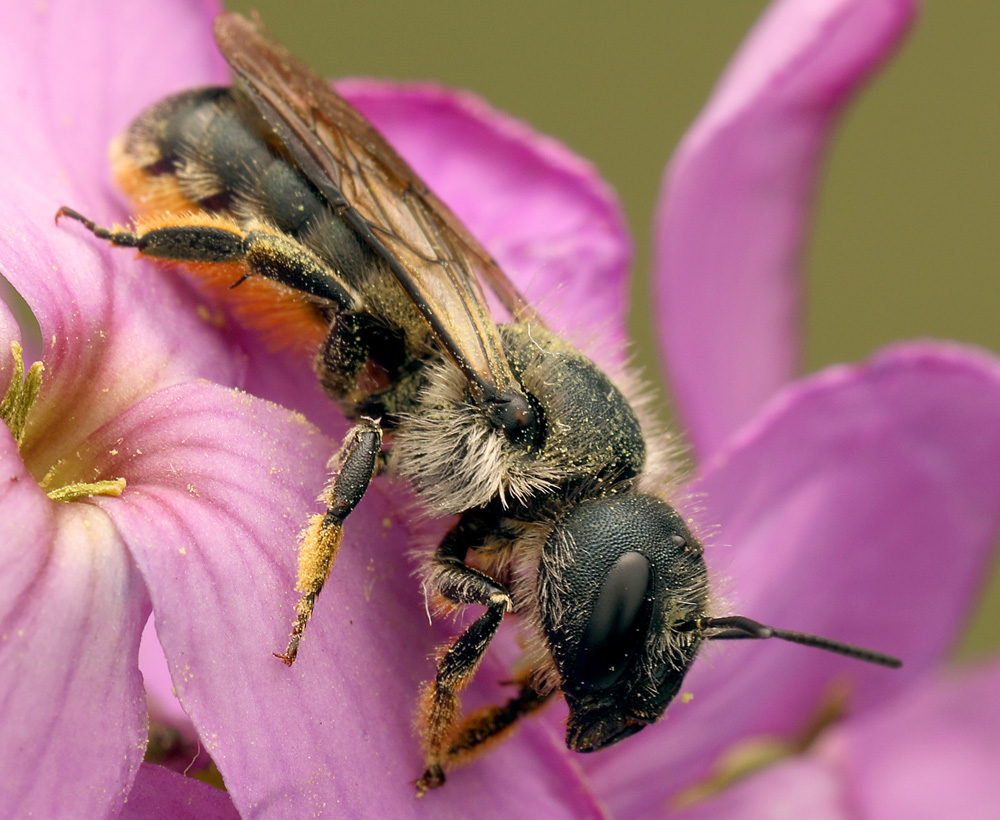
For its reproduction, Osmia brevicornis prefers deadwood with beetle galleries, in which it builds its brood cells. Because deadwood is no longer tolerated in our tidied-up gardens and parks, and above all in modern agriculture, and is consistently cleared away, the populations of this species have declined enormously – it is threatened today. (Photo: © André Rey)
Toxins
Herbicides and pesticides and artificial fertilisers are used across the board in industrialised agriculture. While herbicides and artificial fertilisers act indirectly by reducing the diversity of wild plants and flowers, insecticides harm wild bees quite directly – for pesticides hit not only the pests but every arthropod that comes into contact with them. Systemic insecticides have proved particularly problematic: they are deposited in every part of the plant and so reach the bees through nectar, pollen and guttation (water excreted by the plant).
No account is moreover taken of the cocktail effect these toxins produce with one another and with other environmental toxins (from air and water pollution, for instance): official approvals for herbicides and insecticides consider only the substance to be approved, not the interactions it enters into with other agricultural or environmental toxins; accordingly, no cumulative limits exist for the simultaneous use of several herbicides or insecticides.
Besides modern agriculture, wild bees are coming under increasing pressure from the following causes:
- the growing loss of pioneer sites
- mowing meadows all at once instead of in sequence
- the building over of valuable south-facing sites through settlement
- the fragmentation of natural landscapes by roads and the expansion of settlements
- climate change
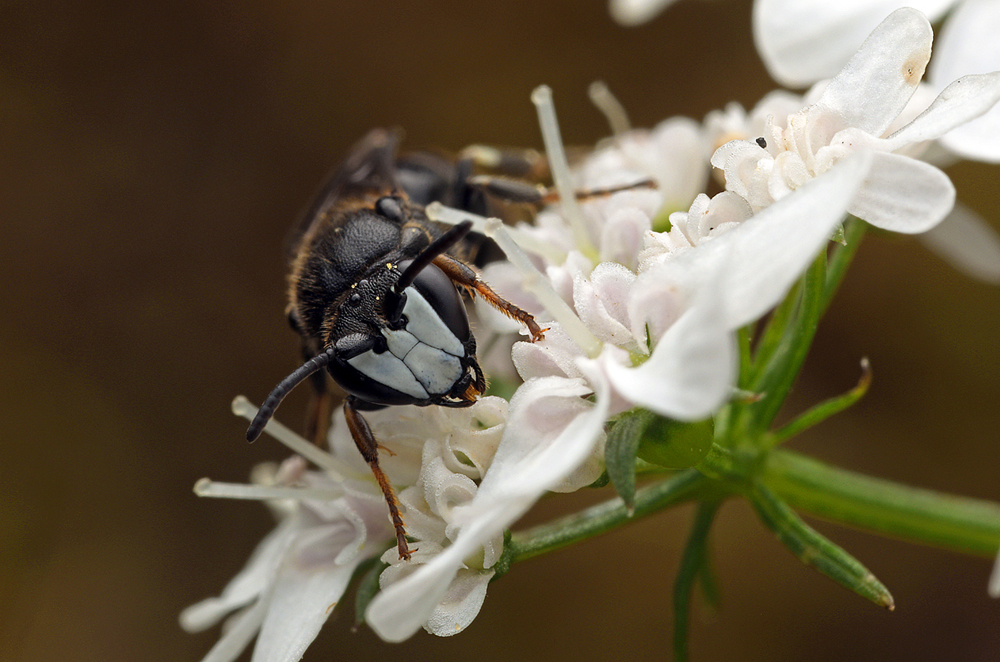
Photo: The females of the yellow-face bee Hylaeus nigritus collect pollen only from composites. They drink nectar, however, from numerous flowering plants. Pictured is a male on cow parsley (photo: © Jürg Sommerhalder)
Nature conservation can do harm too
Management measures for primary and secondary habitats are today regulated at cantonal level. The conversion of hay meadows to grazing land (and the reverse), the timing and frequency of mowing and other management measures must not, however, be applied in a blanket fashion. What André Rey sets out in detail and impressively in his comprehensive article on butterflies at biodivers.ch applies to wild bees as well: static, undifferentiated management measures, whatever the landscape type, carry a high potential for damaging biodiversity instead of the support intended. Rather, measures to preserve and support must without fail take account of the particularly valuable species occurring locally. Defining target species for specific habitats, and action plans built on that, are indispensable for protection schemes meant in earnest.
References
[1] B. K. Klatt et al., “Bee pollination improves crop
quality, shelf life and commercial value.,” Proc. Biol. Sci., vol. 281,
no. 1775, p. 20132440, 2014.
[2] L.
Pfiffner and A. Müller, “Wildbienen und Bestäubung,” FiBL Faktenblatten,
vol. 2014, p. 8, 2007.
[3] M. G.
Park, E. J. Blitzer, J. Gibbs, J. E. Losey, and B. N. Danforth, “Negative
effects of pesticides on wild bee communities can be buffered by landscape
context,” Proc. R. Soc. B Biol. Sci., vol. 282, no. 1809, 2015.
[4] T. P.
Sullivan and D. S. Sullivan, “Vegetation management and ecosystem disturbance:
impact of glyphosate herbicide on plant and animal diversity in terrestrial
systems,” Environ. Rev., vol. 11, no. 1, pp. 37–59, 2003.
[5] C. I.
Nicholls and M. A. Altieri, “Plant biodiversity enhances bees and other insect
pollinators in agroecosystems. A review. Agron. Sustain. Dev. 33, 257–274
(2013).,” Agron. Sustain. Dev. Sustain, vol. 33, pp. 257–274, 2013.
[6] D.
Tommasi, A. Miro, H. a. Higo, and M. L. Winston, “Bee diversity and abundance
in an urban setting,” Can. Entomol., vol. 136, no. 06, pp. 851–869,
2004.
[7] P.
Theodorou et al., “Urban areas as hotspots for bees and pollination but
not a panacea for all insects,” Nat. Commun., vol. 11, no. 1, pp. 1–13,
2020.
[8] A.
Holzschuh, J. H. Dudenhöffer, and T. Tscharntke, “Landscapes with wild bee
habitats enhance pollination, fruit set and yield of sweet cherry,” Biol.
Conserv., vol. 153, pp. 101–107, 2012.
[9] P. G. Wilmer, A. A. M. Bataw, and J. P. Hughes, “The superiority of bumblebees to honeybees as pollinators: insect visits to raspberry flowers,” Ecol. Entomol., vol. 19, no. 3, pp. 271–284, 1994.