Project responsibility:
Sub-project lead “Expert commission”: Dr Rainer Neumeyer
Downloads:
Background
Most people and institutions in this country hold the view that managed honey bees are indispensable and that there cannot be enough of them if food security and biodiversity are to be assured. In fact honey bees are capable of affecting the populations of wild flower visitors, and thereby biodiversity as a whole, adversely.
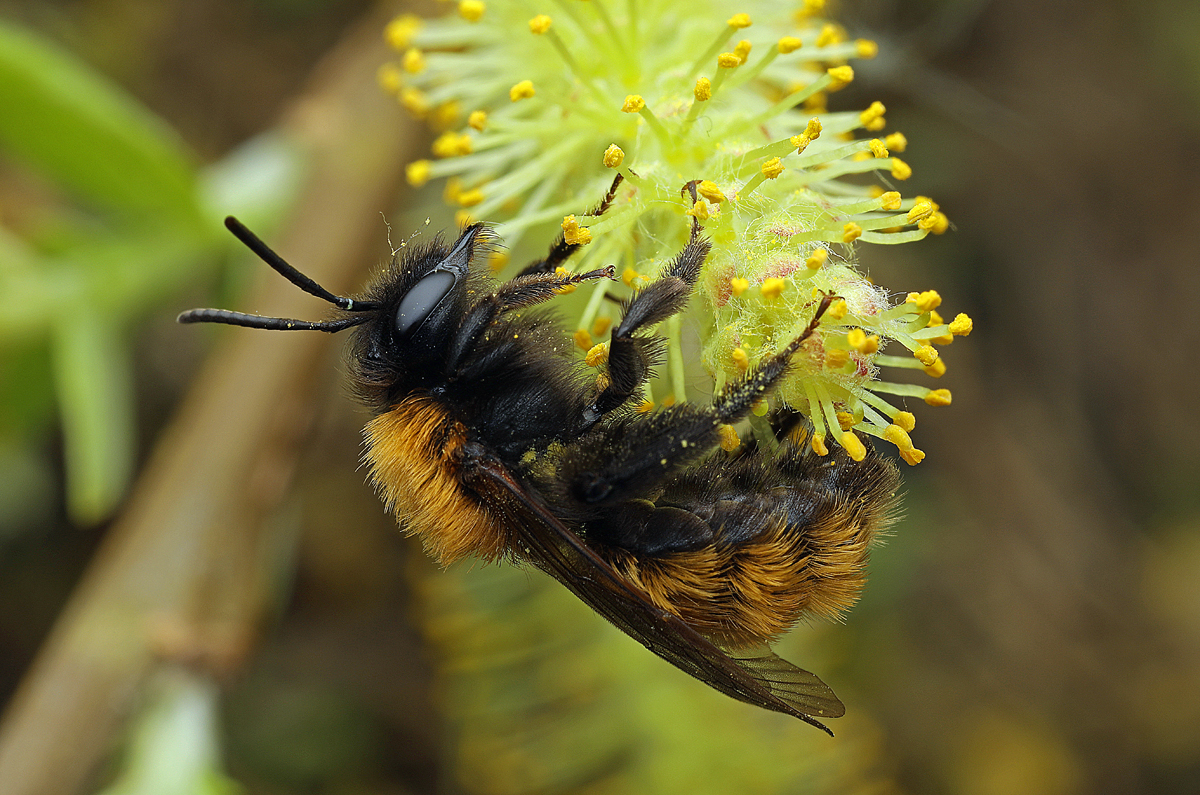
Photo: For building its nest, the tawny mining bee (Andrena fulva) depends on open ground largely free of vegetation. Pictured is a male on a willow flower. (Photo: © Jürg Sommerhalder).
This applies above all when their density is too high, since they compete with wild pollinators for the limited flower resources available. Because we hold that the density of honey bees in Switzerland is in many places far too high, we campaign for beekeeping to be regulated. Not only in nature reserves, but in urban areas too: surveys of recent years show that wild bees are increasingly moving into towns to escape the growing lack of flowers and structures in farmland.
IG Wilde Biene does not intend to call the importance of beekeeping into question in principle, nor to hold beekeepers liable for circumstances that are not of their making. The opposite is the case: among our members and partners are beekeepers and organisations connected with beekeeping who share our view that the uncontrolled spread of ever more managed colonies ought to be regulated — in the interest of all wild pollinators and of genuinely supporting native biodiversity.
The following institutions support this project as partners: